


LG SKS Compact Oven
Pros
- Steam-combi cooking gives the oven a real advantage with reheating, bread, fish, vegetables, and moisture-sensitive foods
- Steam sous vide, air fry, true convection, proof mode, and smart monitoring create a rare level of flexibility in one 30-inch single wall oven
- The 4.7 cu. ft. cavity is practical enough for everyday serious cooking while still fitting a cleaner, more space-conscious premium layout
- The design is excellent: refined, modern, and not overly aggressive
- InstaView, GlideShut, ThinQ control, and the built-in camera add convenience in ways that actually suit the product
- It supports undercounter installation in approved setups, which expands where it can work in a luxury kitchen plan
Cons
- $5,399 is a steep ask for a single wall oven, even one with this much technology
- The 1-liter water tank adds manual refill maintenance
- The oven leans heavily on touchscreen controls and electronics, which will not suit everyone
- This is a product you want to buy only if you are confident you will use the steam features often
- Because it is a built-in, premium, feature-heavy appliance, service quality becomes a major part of the value equation
the combination of steam-combi cooking, steam sous vide, air fry, true convection, app control, camera monitoring, and a premium single-oven format is unusually strong.
the $5,399 price , the manual-fill 1-liter water tank , the heavy reliance on touchscreen controls and software, and the sense that this is an appliance you want to buy only if you are fully committed to what makes it special.
When we talk about the LG SKS Compact Oven, the model we mean is the Signature Kitchen Suite 30-inch Transitional Series Single Wall Oven, model SKSSV3011MT. After spending time with it, what stood out to us most was how clear its mission feels. This is not a luxury wall oven trying to impress with a long feature list and little else.
It is built around one core idea: give serious home cooks more control over moisture, texture, reheating, proofing, bread work, and steam-assisted cooking without demanding the footprint of a larger double-oven setup. In the right kitchen, that makes a lot of sense. In the wrong one, it feels like expensive overkill dressed up in satin stainless steel.
That distinction matters more here than it does with a lot of premium appliances. Some expensive ovens can coast on looks, brand positioning, and the assumption that “high-end” automatically means “worth it.” This one cannot. The SKSSV3011MT has a much more specific case to make. It asks you to care about steam. It asks you to want better reheating, better moisture retention, more flexibility with bread and proteins, and a kitchen that does not have to grow bigger just to gain more cooking options.
If that sounds like the way you actually cook, this oven becomes genuinely compelling. If your routine is mostly sheet-pan dinners, occasional baking, and standard roasting, it is a far harder sell.
What we tested
The hardware is part of what makes this oven easy to understand. On paper and in use, it is a 30-inch single wall oven with a 4.7 cu. ft. cavity, steam-combi convection, steam sous vide, air fry, bake, broil, convection bake, convection roast, proof, warm, RapidHeat Roast+, Auto Cook, and My Recipe modes. You also get true convection, an air fry rack, meat probe, gliding rack, heavy-duty rack, and offset rack, plus both self-clean and a 10-minute Speed-Clean cycle.
The smart layer is equally ambitious. There is Wi-Fi, ThinQ integration, remote operation, voice control, and a Gourmet AI camera that can monitor food inside the cavity, suggest cooking guidance, capture snapshots, and create time-lapse clips. The interface runs through a 7-inch TFT LCD touchscreen, and the overall look is exactly what SKS seems to be aiming for in its Transitional line: sleek, built-in luxury without the more aggressive pro-style aesthetic.
This is also a genuinely space-conscious premium oven. Not compact in the countertop-appliance sense, of course, but compact in the luxury built-in sense. It delivers a strong feature set in a single-oven format and can work in layouts where a larger double stack would feel excessive, both visually and practically.
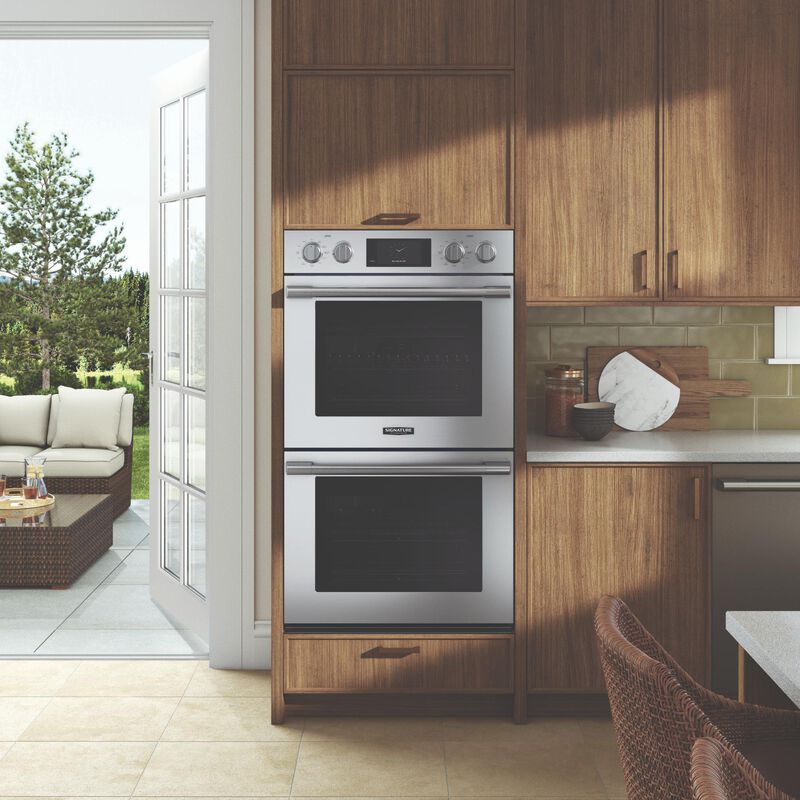
Design and build quality
One of the first things we noticed was that this does not feel like a compromise product. Plenty of premium appliances marketed for smaller or tighter kitchens have a slightly apologetic vibe to them, as if they are trying to soften the blow of giving something up. This one does not. It looks deliberate.
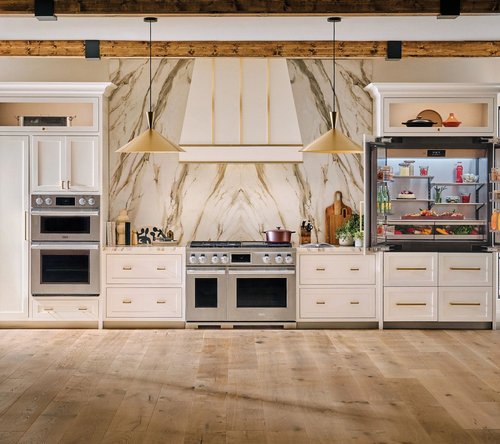
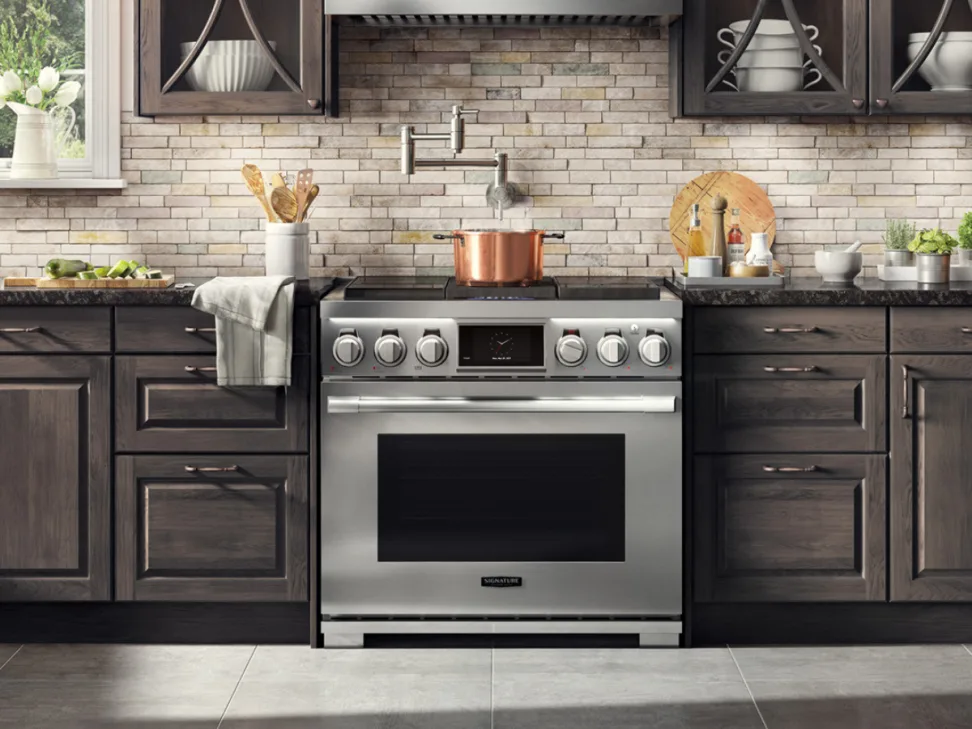
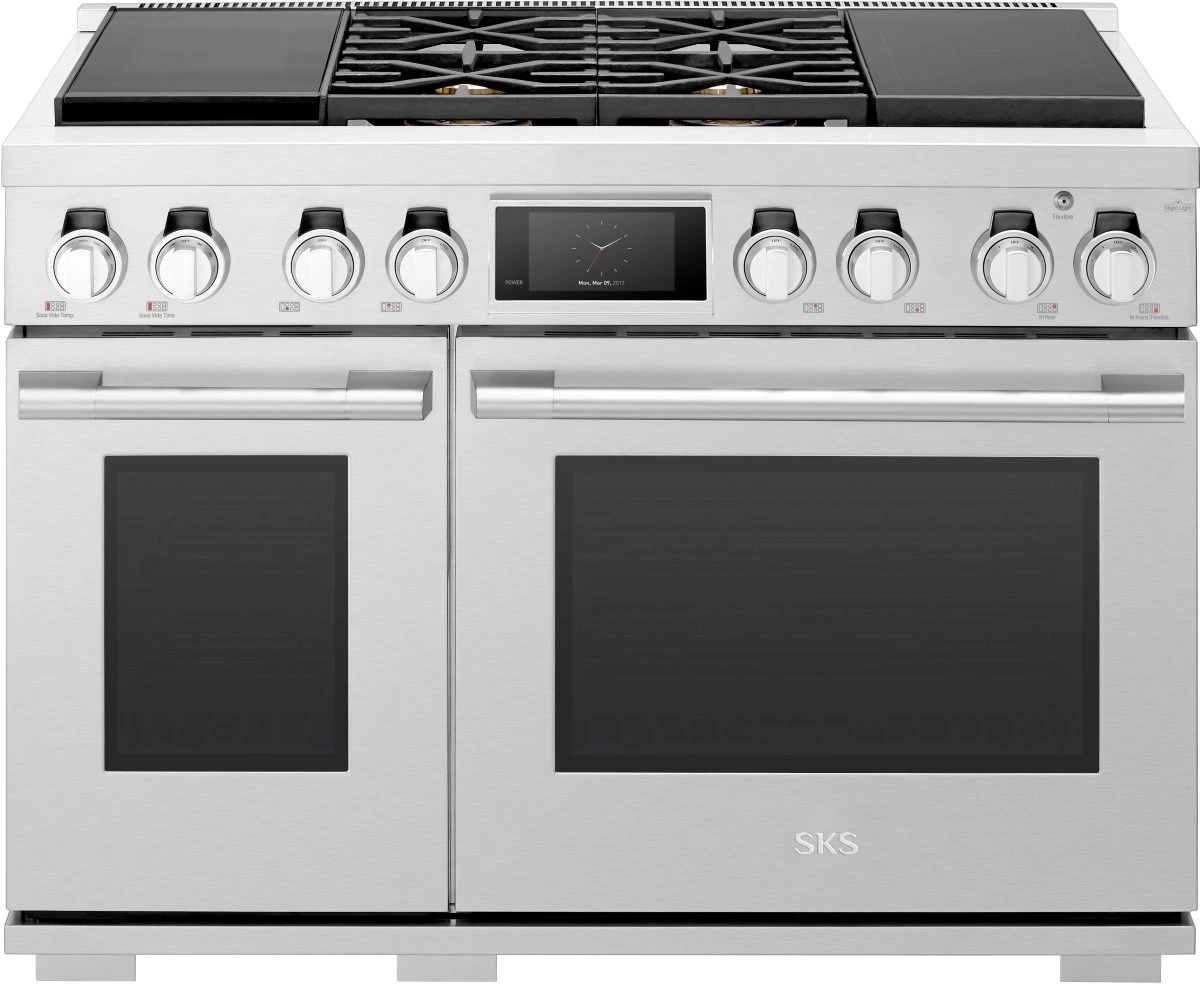
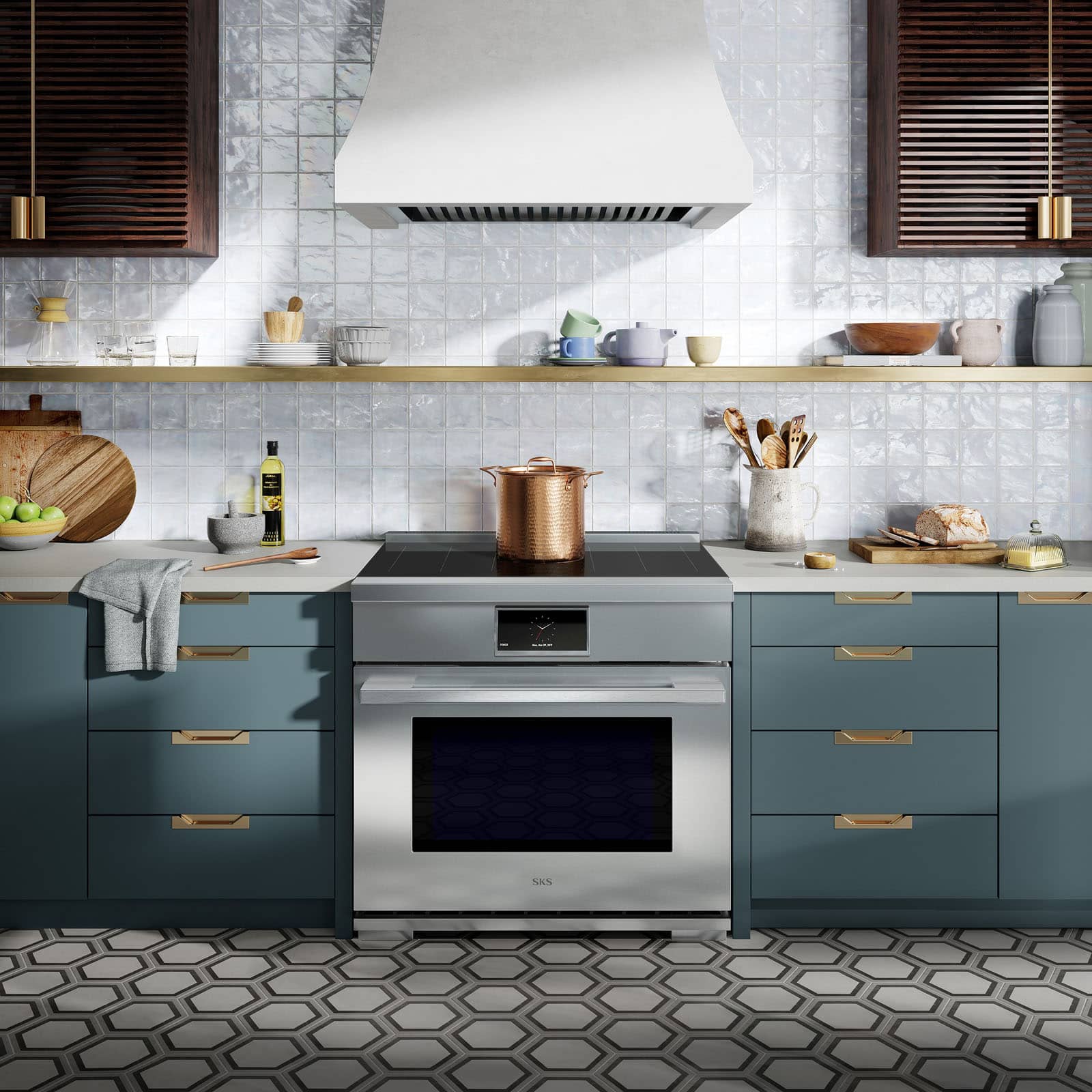
The satin stainless finish works well. The slim handle treatment feels refined rather than flashy. The overall presentation is clean, integrated, and architectural. What we appreciated most is that SKS did not overdo the “professional” styling. A lot of premium wall ovens try too hard to look commercial. This one feels calmer and more tailored, which suits the kind of kitchen it is likely to end up in.
That matters because the buyer for this oven is often not just thinking about cooking modes. They are thinking about cabinetry, line-of-sight, proportions, symmetry, and how an appliance sits inside the room. In that context, the SKS gets a lot right. It looks expensive without shouting. It feels upscale without drifting into visual noise.
The door design is also more useful than it first seems. InstaView and the built-in camera are not just there to make the spec sheet look modern. In actual use, they support the way people cook with steam. When moisture retention matters, opening the door repeatedly is exactly what you want to avoid. Being able to check on food visually without breaking the cavity environment is one of those features that sounds like a luxury trick until you live with it. Then it starts to feel logical.
The other thing we liked is that the oven does not demand a giant installation statement to unlock advanced cooking modes. You are not forced into a towering double-oven wall just to get steam-combi capability. That flexibility is a genuine strength.
Setup and first impressions
This is not a casual appliance upgrade. The moment you deal with installation, that becomes obvious. The oven is a 240V / 208V, 30-amp, hardwired built-in unit. This is a serious renovation appliance, not something you slide in over a weekend and forget about.
That reality changes the buying equation. Once an appliance becomes this integrated into the kitchen, the stakes go up. Installation is more involved. Removal is more involved. Service matters more. Reliability matters more. Every premium feature has to justify itself a little harder when the product is this expensive and this built-in.
Once it is in place, though, the first-use experience feels polished. The 7-inch TFT touchscreen is central to the experience. That will divide buyers immediately. Some people will love the cleaner interface and the sense that the oven feels modern and guided. Others will miss the reassurance of physical controls and regard all-screen appliances with suspicion.
We can see both sides.
What stood out to us is that the interface does not feel chaotic despite the feature load. There is a lot going on here, but the oven generally presents itself in a way that feels manageable rather than intimidating. That matters, because feature-heavy appliances often fail in the first week. If the controls feel annoying or unintuitive early on, many of the advanced modes end up unused. Here, the broader impression is better than that. It feels like a product that wants to be used, not merely admired.
Still, there is no getting around the fact that this is a heavily digitized oven. Touchscreen navigation, smart features, connected services, camera functions, and app integration all add capability, but they also add layers. Buyers who dislike software-dependent appliances should take that concern seriously. In practice, this is not a “set temperature and move on” kind of machine. It is a more involved ownership experience.
Real-world cooking performance
This is where the oven either proves its value or collapses into luxury fluff.
The whole reason to buy this model is steam-combi cooking. That is the center of the product, and it shapes almost everything good about it. In daily use, the biggest strengths show up with foods that suffer in conventional ovens and disappoint in microwaves. Leftovers are the obvious example. Bread is another. Fish, chicken, vegetables, and moisture-sensitive dishes are where this oven makes the strongest case for itself.
That was one of the clearest impressions we had after spending time with it: the appeal here is not abstract. It is practical. If you care about keeping food from drying out, if you hate what ordinary reheating does to texture, or if you have ever wished your oven handled humidity more intelligently, this model starts to make immediate sense.
Reheating is one of the most underrated reasons to want steam. A lot of expensive cooking appliances are bought for aspirational meals and ignored during ordinary life. This oven has the opposite advantage. It can justify itself in the small, repetitive moments. Rice that does not go hard. Vegetables that do not shrivel. Chicken that does not feel like punishment the second time around. That sort of thing matters because it is how real households actually use appliances.
Bread is another strong use case. The combination of steam support, proof mode, and true convection gives this oven a very appealing skill set for anyone who bakes seriously. Good bread benefits from better humidity control. That is not a niche observation. It changes how dough proofs, how crust develops, and how much finesse you can bring to the process without improvising around a standard oven’s limitations.
Fish is also a natural fit. So are gentler protein cooks more broadly. When we think about the buyers who will get the most from this oven, it is not just people chasing “chef” features. It is people who actually notice texture. People who care when salmon goes chalky. People who want vegetables to stay vibrant rather than collapse into a dry roast. People who want a better middle ground between microwave convenience and standard-oven bluntness.
Steam sous vide
The steam sous vide mode is one of the more intriguing parts of the package. It is not there as a gimmick. It fits the oven’s broader identity: controlled moisture, better texture, and more precision without asking you to bring yet another appliance into the kitchen.
For the right buyer, this opens up a more ambitious side of the oven. It gives you another way to approach proteins and more delicate cooking jobs, especially if you are curious about sous-vide-style results but want them inside an integrated wall oven rather than as a separate workflow on the counter. We would not pretend everyone will use this often. Many buyers will not. But the feature makes sense here in a way it would not in a more generic oven.
Air fry
The air fry function is no longer a headline-maker by itself. Nearly every premium oven wants that badge now. But in this case, it feels appropriately included rather than lazily added. If one of this oven’s main appeals is consolidating multiple cooking roles into one built-in appliance, air fry belongs here.
The real benefit is not that it replaces every dedicated air fryer on the market. It is that it reduces counter clutter and makes the oven more complete. For buyers doing a clean, high-end kitchen, that matters. It is one more reason this oven can serve as a real center-of-gravity appliance instead of a specialized luxury toy.
Conventional cooking still matters
One thing we appreciated is that the oven does not force a choice between advanced cooking modes and normal usefulness. You still get the expected fundamentals: bake, broil, convection bake, convection roast, proof, warm, and meat probe support. That sounds ordinary, but it matters. A premium oven with steam ambitions still has to handle weeknight basics and holiday staples. This one appears built with that expectation in mind.
That said, the 4.7 cu. ft. capacity does define the product. It is roomy enough to feel like a true main oven, not some narrow specialty cavity. But it is still a single oven, and it is not the natural choice for buyers who judge every wall oven by how effortlessly it can handle huge holiday-volume cooking. This is a flexibility-first appliance, not a brute-force-capacity appliance. That is an important difference.
Smart features and day-to-day convenience
The Gourmet AI camera is the most obvious point of debate, and we understand why. Some buyers will see it as exactly the kind of smart feature they want in a luxury kitchen. Others will see it as one more thing standing between them and a simpler oven.
In practice, we think it works best when you treat it as a convenience layer rather than the main attraction.
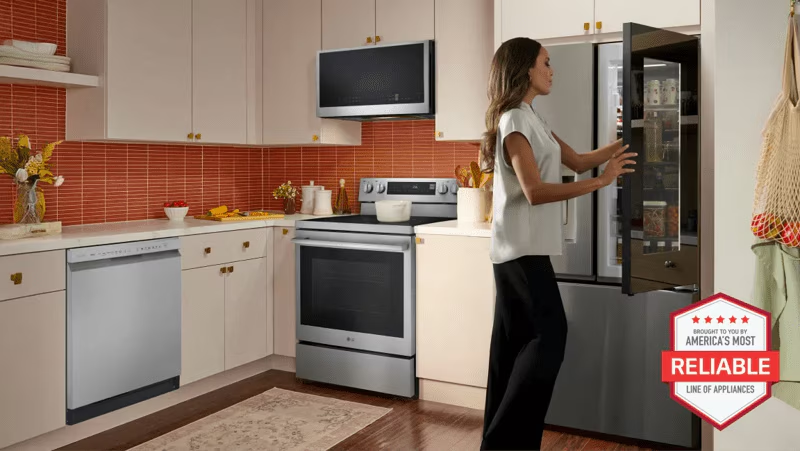
Being able to monitor food without opening the door makes sense. Watching a loaf, checking a roast, or keeping an eye on something delicate without losing heat or steam is useful. So is remote viewing when you are elsewhere in the house. The same goes for app control and voice integration. None of these are reasons to buy the oven by themselves, but together they contribute to a more modern, more hands-off ownership experience.
Where we felt less convinced was in the broader promise of “smartness” as a selling point. The oven’s cooking system is the real reason to want it. Moisture control is the real reason to want it. Texture is the real reason to want it. The camera and cloud-connected features are secondary. Nice to have, coherent with the product, and at times genuinely helpful, yes. But secondary.
That distinction is worth keeping in mind, because it helps separate the real value of this appliance from the parts that are easiest to market.
Flaws and frustrations
The biggest problem is obvious: price.
At $5,399, this oven sits in a bracket where every compromise feels more expensive. That does not automatically make it overpriced, but it does mean buyers need a very clear answer to one question: why this oven, specifically?
If the answer is “because we cook constantly, care about steam, want one elegant cavity to handle more tasks, and do not want to clutter the kitchen with extra appliances,” the price starts to make sense. If the answer is mostly aesthetic or aspirational, it becomes much harder to defend.
The next frustration is the 1-liter manual-fill water tank. On one hand, it simplifies installation. You are not dealing with a plumbed steam setup, which makes planning easier and broadens where the oven can work. On the other hand, if you actually lean on the steam functions, refilling becomes part of ownership. Not disastrous. Not shocking. But real. And at this price, small ownership chores feel bigger.
We also think buyers should be honest with themselves about the touchscreen-heavy design. The interface is cleaner and more contemporary than many traditional ovens, but this is still a product that leans heavily on software and electronics. If you are the kind of person who gets irritated when an appliance feels more like a device than a machine, that irritation will not go away after installation.
Then there is the broader confidence question. This is a premium, feature-dense, built-in appliance. That means support quality matters. Dealer quality matters. Service access matters. We would not buy something like this casually. We would buy it only through a dealer we trust and only in a market where support is genuinely reachable.
That caution is not a minor footnote. It is part of the ownership experience.
Value for money
The most honest way to frame the value is this: the LG SKS Compact Oven is not broadly good value. It is specific value.
If you genuinely use what makes it special, it can justify itself. If steam-combi cooking becomes part of your weekly life, if proof mode matters, if better reheating matters, if built-in consolidation matters, this oven starts to feel rational. It gives you a lot in one cavity. It looks the part. It fits a cleaner kitchen plan than a larger combo setup. And it has an identity, which we think matters more than people admit in the luxury appliance category.
If, however, you mostly want a premium wall oven for standard roasting and baking, the case weakens dramatically. There are simpler ways to spend this kind of money. Easier ways. Safer-feeling ways. This is not the default recommendation for someone shopping upscale. It is a recommendation for someone who specifically wants what this oven does unusually well.
That is the key point. You should buy this because you will use its special tricks all the time, not because you admire them from a distance.
Who should buy it
We would point this oven toward buyers building a serious kitchen in a smaller or cleaner footprint who do not want a standard luxury wall oven with a prettier badge. It makes the most sense for people who cook often, care about texture, and know they will use steam in real life.
That includes people who bake bread, proof dough, reheat leftovers carefully, cook fish regularly, care about moisture retention in proteins, and like the idea of consolidating multiple cooking tools into one integrated appliance. It also suits buyers who want a premium built-in look without committing to a larger and more visually dominant oven stack.
In other words, this is for the buyer who wants capability per inch, not just status per inch.
Who should skip it
We would skip this oven if the household mostly wants conventional baking and roasting with minimal fuss. We would also skip it if app-driven appliances already annoy you, if you prefer physical controls, or if you do not trust premium after-sales support in your area.
Most importantly, skip it if you are drawn to the idea of steam more than the reality of using it. That is the easiest way to end up with an appliance you admire more than you need.
Final verdict
The LG SKS Compact Oven, specifically the Signature Kitchen Suite SKSSV3011MT, is one of the more interesting luxury wall ovens we have spent time with because it actually has a point of view. It is not trying to be everything to everyone. It is a steam-first, flexibility-first, design-conscious premium oven for buyers who cook in a way that makes those strengths matter.
We liked that clarity. We liked that it does not feel like a compromised “compact” product. We liked that the design is sharp without being loud. We liked that the steam functions are tied to real daily benefits rather than vague marketing promises. And we liked that this oven can genuinely make a single built-in cavity do more than a standard premium wall oven usually does.
But we would not call it an easy recommendation. The price is high. The water tank is one more task. The smart layer will not appeal to everyone. And this is not the sort of appliance we would buy without confidence in the dealer and support behind it.
Still, judged on what it is trying to be, it works. For the right buyer, it feels smart, distinctive, and genuinely useful. For the wrong buyer, it is simply too much oven, too much feature density, and too much money. That is exactly why this is such a compelling product for some kitchens and such an unnecessary one for others.
FAQ
Is the LG SKS Compact Oven actually compact?
Yes, but only in the luxury built-in sense. It is still a 30-inch wall oven, not a tiny specialty appliance. “Compact” here means it delivers advanced steam-combi capability in a single-wall-oven format and can fit projects where a larger double-oven setup would feel excessive.
Does this model include microwave or speed-oven functionality?
No. The SKSSV3011MT is a steam-combi convection wall oven with air fry and steam sous vide, but it is not the microwave-equipped combination model. That distinction matters because “combi” often gets misunderstood.
Is the steam function actually useful?
Yes, and in our view it is the entire reason this oven deserves attention. Steam matters when you care about moisture retention, gentler reheating, bread, proofing, vegetables, fish, and proteins that are easy to dry out in a conventional oven.
Do you need a water line?
No. This model uses a 1-liter water tank, so it is a reservoir-based steam system rather than a plumbed one. That simplifies installation but adds manual refilling to ownership.
Is the Gourmet AI camera worth having?
It can be. We found it most useful as a convenience feature rather than a deciding feature. If you like checking on food without opening the door, it adds something real. If you just want straightforward oven performance, it will feel less essential.
Is it a good oven for bread baking?
Yes. Bread is one of the clearest reasons to want this oven. The combination of steam support, proof mode, and true convection gives it a very compelling bread-baking profile.
Is it worth the money?
It is worth it if you will actually use steam-combi cooking regularly and want that flexibility in a premium single-wall-oven format. It is not worth it if your needs are mostly basic and your attraction is mainly to the idea of owning something high-end.
Explore the LG SKS Compact Oven Gallery
Every image from this article, gathered in one clean place. Tap any photo to open it larger.