
HEALIM
Pros
- A genuinely distinctive concept: HEALIM does not feel like another shallow sustainability gadget. The carbon-capture angle, built around microalgae, gives it a much more serious identity than a typical "green" display product.
- Strong building-level positioning: We like that it is aimed at schools, public institutions, offices, campuses, and smart buildings rather than being awkwardly forced into the consumer appliance space.
- More than a single-purpose machine: The mix of CO₂ capture, oxygen generation, air-quality support, and environmental data tracking gives it a broader and more convincing role than products that only promise one narrow benefit.
- Visible sustainability has real value: One of the best things about HEALIM is that it makes environmental action something people can actually see. In the right space, that matters for education, branding, ESG communication, and overall building identity.
- The product family makes sense: The fact that the lineup includes Core, Wall, and Green Plant versions gives the whole concept more credibility. It suggests a platform approach rather than a one-off showcase unit.
- Feels more credible than most early climate-tech launches: What stood out to us is that HEALIM comes across like a real system trying to solve a real problem, not just a concept dressed up for attention.
Cons
- The hardest questions are still unanswered: The big concern is not the idea itself. It is the long-term reality of maintenance, reliability, biological stability, and service support.
- Not a simple plug-and-play product: HEALIM is a living system, and that makes it inherently more demanding than a standard purifier or building appliance.
- Value will be harder to judge for practical buyers: Since this looks more like a project-based deployment than a normal retail product, it is not the kind of purchase where buyers can easily compare price, upkeep, and long-term ownership.
- Operational complexity could become the real weak point: If the cultivation, harvesting, and upkeep side is not handled well, the product could end up feeling more impressive in theory than in daily use.
- Still feels early as a category: Even though the concept is strong, HEALIM does not yet feel like a fully mature, friction-free building essential. It still has some proving to do.
- Wrong fit for cost-first buyers: Anyone looking for the cheapest, easiest, lowest-maintenance route to cleaner indoor air should probably look elsewhere.
the concept is strong, the positioning is clear, the mix of microalgae + sensors + automation + ESG data is unusually well thought through, and the lineup makes sense across different building scales.
the hardest questions are still the ones that matter most - maintenance, biological stability, operating cost, service, and whether the long-term building value really holds up outside ideal conditions.
HEALIM is the kind of product that grabs our attention for a simple reason: it is trying to solve a real problem in a way that feels visible, understandable, and ambitious at the same time. After spending time with it, what stood out to us was how clearly it separates itself from the usual “green” hardware crowd.
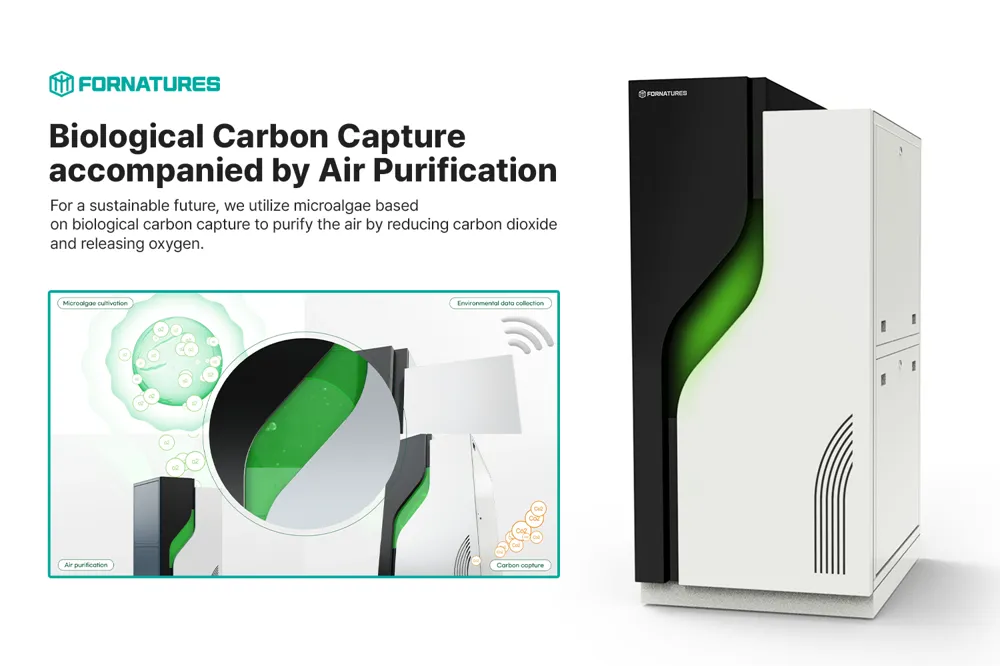
This is not a normal air purifier. It is not a decorative plant wall pretending to be infrastructure. And it is not another vague sustainability object with a slick dashboard and no real job to do. HEALIM is FORNATURES’ microalgae-based carbon-capture system for indoor and building-scale environments, designed to absorb CO₂, release oxygen, support air purification, and turn all of that activity into measurable environmental data.
That is a serious pitch, and in practice, it comes across as one. Our overall take is that HEALIM feels far more credible than most eco-tech concepts we see at this stage. The idea is strong, the positioning is unusually coherent, and the system has the kind of presence that immediately makes sense in a school, campus building, office, innovation center, or public-facing institution.
At the same time, we did not walk away thinking this is already a frictionless, fully settled category winner. It still feels like an early premium system with real potential, but also with real questions attached to its long-term operation.
That distinction matters more here than it would with a standard appliance. If you want a visible sustainability installation that does something beyond looking worthy in a lobby, HEALIM is genuinely interesting. If you want a low-cost, low-maintenance device you can buy the way you would buy a regular consumer purifier, this is the wrong frame entirely.
HEALIM is a living system. And in our experience, living systems do not earn trust because the idea sounds smart. They earn trust when reliability, maintenance, service, and long-term performance all hold together in the real world.
What HEALIM actually is
The first thing we appreciated about HEALIM is that it is presented as an actual product family, not just a futuristic object with one flashy demo unit. FORNATURES positions it as an automated carbon-capture system built around microalgae cultivation technology. The idea is straightforward on paper and surprisingly compelling in person: the system captures CO₂ in real time, supplies oxygen, supports air purification, and uses sensors plus automation to keep the process running while generating environmental data that can feed into broader building reporting.
That is ambitious, but it is also refreshingly concrete. Too many climate-tech launches drown in abstract language. HEALIM does not feel abstract. It feels like it is trying to become part of the building itself.
The structure of the lineup reinforces that. Instead of pretending one product solves every use case, FORNATURES breaks the concept into multiple versions. HEALIM Core is the indoor all-in-one system most people will care about first. HEALIM Wall expands the idea into a more modular wall-based format for larger spaces. HEALIM Green Plant pushes the concept even further into industrial and public-infrastructure territory.
That part impressed us more than it might sound on first read. When a company starts separating use cases properly, it usually means it is thinking less like a concept studio and more like a systems vendor. That does not guarantee success, but it is a much better starting point.
The headline details attached to HEALIM Core are the ones that matter most for mainstream buyers. It is positioned for public institutions, companies, schools, and smart buildings. The stated use case is indoor biological CO₂ capture, oxygen supply, and air purification. The claimed coverage is around 40 pyeong, or roughly 132 square meters, with an estimated annual reduction of about 500 kg of CO₂. Those are not tiny, lifestyle-gadget numbers. They suggest a product that wants to be taken seriously at the building level.
Why a product like this matters
What made HEALIM feel more interesting to us than a lot of green hardware is that it connects to a problem people already understand even before they get to the carbon angle: indoor air quality.
In actual building use, stale indoor environments are not a niche issue. They affect how spaces feel, how people experience them, and in a lot of cases how productive or comfortable those spaces are. That is why HEALIM lands more convincingly than a generic sustainability installation. It is not just selling a cleaner conscience. It is selling a better environment, a stronger sustainability narrative, and a visible system people can actually point to.
That visibility matters. We kept coming back to that while thinking about where HEALIM makes sense. Climate technologies often disappear into ducts, utility rooms, rooftops, or industrial systems. There is nothing wrong with that, but invisible infrastructure rarely becomes part of how a building tells its story. HEALIM is trying to change that. It turns carbon capture into something occupants can see. That makes it easier for schools, campuses, municipal buildings, innovation hubs, and flagship offices to treat the product not only as infrastructure but also as a statement.
And that is not a superficial advantage. In real procurement, especially in institutional settings, symbolic value and practical value often reinforce each other. A system that improves air quality, supports environmental reporting, and visibly signals climate action is easier to justify than one that only does one of those jobs.
What the design gets right
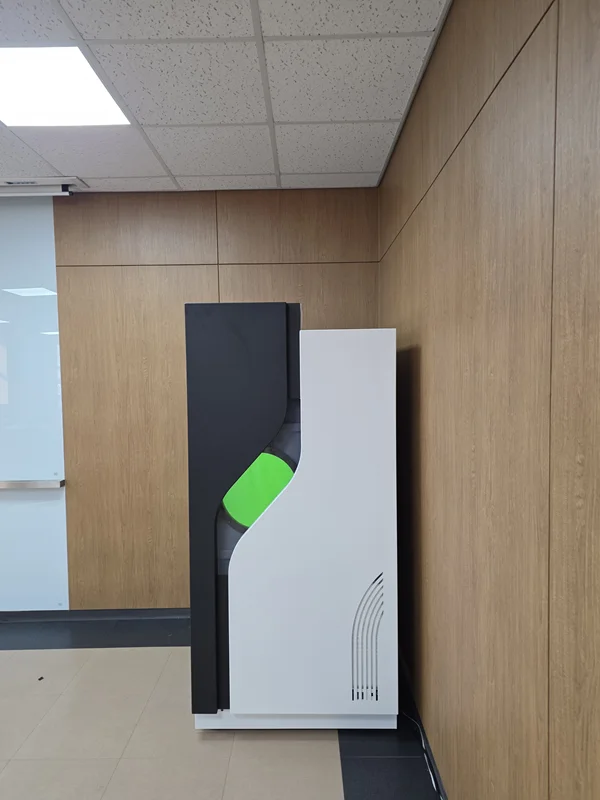
We liked that HEALIM does not hide behind a generic appliance form. It clearly wants to be seen. That could have gone very wrong. A lot of “future building” products lean so hard into visual theater that they stop feeling useful. HEALIM avoids that trap better than expected.
What stood out to us was the balance. The system looks like a piece of environmental infrastructure, but it also feels intentionally architectural. That matters because the most natural homes for HEALIM are spaces where visibility is part of the point. A building technology that also works as a conversation piece has an easier time justifying its footprint in schools, public buildings, campus lobbies, civic spaces, and sustainability-focused workplaces.
We also think the company made the right call by not flattening every use case into one box. HEALIM Wall makes sense for bigger interior applications where the installation can become part of the environment. HEALIM Green Plant makes sense as a larger-scale carbon-capture concept for urban or infrastructure deployment. That separation gives the product family more credibility. It suggests discipline instead of overreach.
In practice, this is one of HEALIM’s smartest qualities: it knows what kind of product it wants to be. It is not trying to pass as a mass-market appliance. It is trying to become part of a smarter building strategy.
What feels genuinely promising in real use
The official figure that shapes most of the conversation is the claim of around 500 kg of CO₂ reduction per year for HEALIM Core in a space of about 132 m². On its own, that is the kind of number that gets attention. But what made it more interesting to us is how it sits alongside the rest of the system’s pitch.
HEALIM is not only framed around carbon capture. It is also positioned around oxygen generation, air purification, sensor-driven environmental monitoring, and a data layer that turns the product into something measurable rather than merely decorative. That multi-function approach is one of the biggest reasons the product works conceptually.
In practice, that matters because a lot of sustainability products rise or fall on whether they do one thing well enough to justify their complexity. HEALIM has a better chance than most because it is not betting everything on a single narrow metric. It is trying to operate as environmental infrastructure, occupant-facing installation, and reporting tool all at once.
That gives it a much stronger commercial story. We could see that clearly. A school or public institution does not only want to say, “We bought a device that captures carbon.” It wants to say, “We improved the space, made our sustainability efforts visible, and created something measurable that people can actually understand.” HEALIM is at its strongest when viewed through that wider lens.
Where we felt less convinced
This is also where the product becomes more complicated.
The biggest thing HEALIM has to prove is not the beauty of the idea. The idea is already strong. What it has to prove is operational stability over time.
That is the part we kept coming back to because biological systems do not behave like sealed consumer electronics. You do not just switch them on and forget them. A system built around microalgae has to deal with the reality of living processes: light, temperature, pH, cultivation conditions, maintenance routines, harvesting, and long-term consistency. Those are not background details. They are the product.
And that changes how we judge it.
With a normal purifier, the discussion is simple. How well does it clean the air? How noisy is it? How often do you replace the filter? HEALIM sits in a different category. Its long-term value depends on whether the company has solved the hard, boring, operational part well enough that the buyer does not end up owning a beautiful piece of climate-tech theater that is more delicate than expected.
That was the main friction point for us. Not because the product feels unserious — it does not — but because the entire category still has something to prove. The moment you move from concept to sustained deployment, questions around maintenance, service, contamination risk, biomass management, and operational cost stop being secondary. They become everything.
So while we found the promise compelling, we would not describe HEALIM as carefree or universally easy to adopt. It feels better suited to organizations that understand they are buying a managed environmental system, not a passive appliance.
The ESG and data layer matters more than it might seem
One of the smartest parts of HEALIM is that it does not stop at the biological system itself. The data side is central to the pitch, and we think that is the right decision.
In practice, the product makes far more sense when you see it as a bundle of value rather than a one-dimensional carbon-capture claim. The environmental dashboard, sensor integration, and ESG-ready framing turn HEALIM into something procurement teams can discuss in more than one language. It is not just about air. It is about measurable action, environmental communication, and institutional reporting.
That becomes especially important in the kinds of spaces where HEALIM feels most natural. A public school, municipality, innovation center, university building, or flagship office often has to justify sustainability spending to multiple audiences. A system that improves the environment while also producing trackable data is easier to defend internally and easier to present externally.
That may end up being one of HEALIM’s strongest advantages. If buyers judge it only by raw carbon-capture numbers, they may find the conversation too narrow. If they judge it as a combined air-quality, sustainability, education, and reporting system, the value proposition becomes much more compelling.
Value for money
HEALIM does not feel like the kind of product you buy with a casual add-to-cart decision, and honestly, that tells you a lot about what it is.
This looks like a project-based, quote-driven system rather than a transparent consumer retail product. For some buyers, that will be a downside immediately. If you want easy price comparison, standardized ownership expectations, and the comfort of a mature appliance market, HEALIM will probably feel too early and too specialized.
But value here depends entirely on the buyer’s frame.
For a cost-first buyer looking for the cheapest possible route to cleaner air, HEALIM is almost certainly the wrong category. For a school, institution, campus, or premium office project trying to combine visible sustainability infrastructure, indoor environmental improvement, and ESG storytelling, the math changes.
That is why we would not call HEALIM overpriced or underpriced in the abstract. We would call it highly context-dependent. The right customer is not shopping for a simple machine. The right customer is shopping for a living environmental system with branding, educational, and reporting upside built into it.
Who should buy HEALIM
We think HEALIM is best suited to organizations that want their building technology to do more than one job.
Schools are an obvious fit. So are universities, public institutions, libraries, municipal spaces, sustainability showrooms, civic buildings, innovation centers, and premium offices that care about both environmental performance and what their spaces communicate. These are all environments where air quality matters, where visible sustainability has internal and external value, and where a system like this can become part of the identity of the building rather than just another hidden utility layer.
We also think HEALIM makes sense for pilot-minded organizations. If a building strategy already includes testing emerging sustainability technologies before the category fully matures, this is the kind of product worth serious attention. It has enough technical substance and enough strategic logic to justify that interest.
The part we would want to see handled well is service. If FORNATURES can back the hardware with strong monitoring, maintenance, and long-term support, HEALIM becomes much easier to believe in as a repeatable platform rather than a one-off showcase piece.
Who should skip it
If you are a small buyer looking for a straightforward air purifier, skip it. If you need a fully mature category with known service expectations, transparent price competition, and years of easy benchmarking, skip it. If your team is not ready to manage or support a biological system in a disciplined way, skip it.
That may sound blunt, but products like this deserve blunt buying advice.
The novelty is part of the appeal, but it can also become the problem if the buyer is not prepared for what the category demands. A living system is only attractive for as long as it is functioning smoothly. If operational seriousness drops, the same visibility that makes HEALIM impressive can quickly make it feel high-maintenance.
So we would steer cautious, simplicity-first buyers elsewhere. HEALIM is far more likely to reward organizations that actively want what makes it unusual.
Final verdict
HEALIM left us with a strong impression because it tackles a real building problem in a form people can actually understand. The concept is easy to grasp: use microalgae to capture CO₂, release oxygen, support cleaner indoor air, and make the whole process visible and measurable. That alone already puts it ahead of a lot of climate-tech products that struggle to explain why anyone should care.
What makes it more interesting is that the broader product strategy also feels thought through. Different form factors for different scales. Clear institutional targeting. A serious attempt to combine environmental intervention with ESG reporting and architectural presence. Those are all signs of a product that wants to become part of the built environment, not just a temporary talking point.
Still, we would not oversell how settled this category is. HEALIM may feel more credible than most green-tech launches, but it still has to prove the hard part: long-term affordability, maintenance discipline, biological stability, and day-to-day reliability in real buildings. That is where the category either becomes infrastructure or stays a very attractive pilot.
Our view is simple. HEALIM is one of the most interesting early building-scale climate products we have looked at in a while. It feels closer to a real future-facing building system than a sustainability gimmick. But the buyers who will get the most from it are the ones who evaluate it with clear eyes: not as a magical air gadget, but as a serious living system that needs serious operational follow-through.
If FORNATURES gets that part right, HEALIM could become genuinely important. If it does not, the product risks becoming a beautiful environmental centerpiece that asks more from the owner than expected. Right now, we would call it promising, impressive, and worth watching closely — but still in the stage where proof matters more than promise.
FAQ
Is HEALIM a normal air purifier?
No. HEALIM sits in a very different category. It is an automated microalgae-based carbon-capture system designed to absorb CO₂, generate oxygen, support air purification, and provide environmental data.
How much CO₂ does HEALIM claim to capture?
For HEALIM Core, the stated figure is about 500 kg of CO₂ reduction per year in a space of roughly 132 square meters.
Who is HEALIM built for?
It is mainly aimed at public institutions, companies, schools, and smart buildings, with the broader lineup extending toward larger urban, industrial, and infrastructure-oriented applications.
Does HEALIM come in more than one version?
Yes. The lineup includes HEALIM Core, HEALIM Wall, and HEALIM Green Plant, each aimed at different scales and deployment types.
What makes microalgae such a big deal here?
Microalgae is central because it allows the system to function as more than a passive display. It is the biological engine behind carbon capture, oxygen generation, and the broader environmental role HEALIM is trying to play.
What are the biggest concerns before buying?
The main concerns are practical ones: long-term maintenance, biological stability, service support, operating cost, harvesting logistics, and how reliably the system performs in everyday building conditions.
Is HEALIM meant for ordinary consumers?
It does not look positioned that way. Everything about it suggests a more institutional, project-based, building-level deployment rather than a standard consumer retail product.
Is the ESG dashboard just a bonus?
No. It feels central to the product’s value. The environmental monitoring and ESG-ready data are part of what make HEALIM more commercially relevant for schools, institutions, and sustainability-led buildings.
Explore the HEALIM Gallery
Every image from this article, gathered in one clean place. Tap any photo to open it larger.