
GE Profile Smart 4-Door French-Door Refrigerator with Kitchen Assistant
Pros
- Scan-to-List is one of the smartest and most realistic smart-fridge features we have seen.
- The separate temperature-controlled middle drawer adds real day-to-day usefulness.
- Door-in-door storage and deep bins make frequently used items easier to access.
- The LED light wall improves visibility more than expected.
- AutoFill and Precise Fill are genuinely convenient in daily use.
- The 8-inch touchscreen feels restrained instead of gimmicky.
- The FridgeFocus camera targets a genuinely useful area of the fridge.
- Privacy details like the physical camera shutter show more thought than usual.
- The underlying refrigerator platform already feels premium and practical.
Cons
- This is still an expensive refrigerator.
- The smart layer is only worth paying for if you will truly use it.
- Door bins run warmer than the main compartment, so storage choices matter.
- Ice production is only average for a premium model.
- Produce preservation is good, but not obviously best-in-class.
- Long-term trust in the software ecosystem still has to be earned.
The Scan-to-List system is one of the smartest ideas we have seen in this category, the FridgeFocus camera targets the part of the fridge people actually forget about, the 8-inch touchscreen stays restrained, and the core refrigerator layout is genuinely strong. We also liked the separate drawer, the LED light wall, the door-in-door storage, and the water-dispensing features that feel useful every day.
It is still an expensive refrigerator, the smart ecosystem still has to prove long-term staying power, the door bins are not the coldest area of the fridge, ice production is only average for this price level, and produce preservation does not feel obviously class-leading across every aspect of the design.
The GE Profile Smart 4-Door French-Door Refrigerator with Kitchen Assistant gets something right that most smart fridges still miss: it feels like a refrigerator first and a tech product second. After spending real time with it, what stood out to us was not the screen, the voice assistant, or the app tie-ins in isolation.
It was the fact that GE aimed all of those things at real kitchen friction—forgetting what you need, losing track of produce, and wasting time during grocery planning. That makes this refrigerator far easier to take seriously than the usual “look, there’s a tablet on the door” approach.
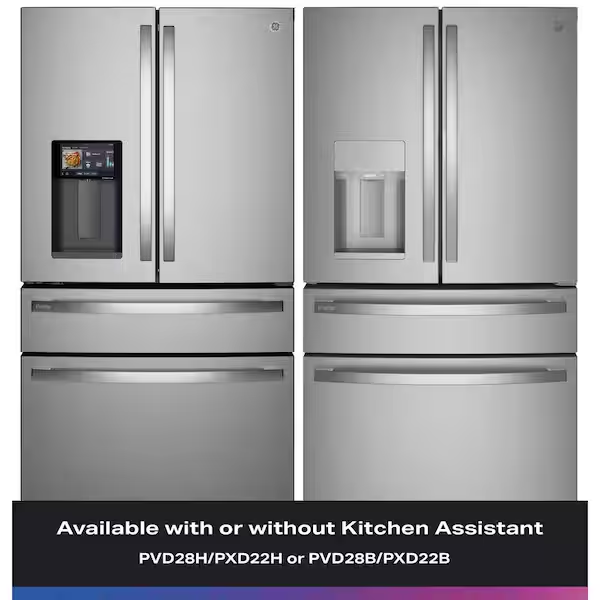
The main model most shoppers will care about is the GE Profile PVD28HYYFS, a 27.9-cu.-ft., standard-depth, four-door French-door refrigerator. There is also a counter-depth version, the PXD22HYYFS, with 22.4 cu. ft. of capacity. Both sit in the premium tier, and both are clearly meant for buyers who want a high-end layout with a layer of smart convenience that actually earns its place.
Our view is simple: if the Kitchen Assistant features match how your household really shops, plans meals, and uses the fridge every day, this is one of the most convincing smart refrigerators we have seen in a while. If you just want raw refrigeration value and care very little about connected features, the extra digital layer becomes harder to justify.
What gives this appliance credibility is that the smart story is built on a refrigerator platform that already makes sense. The four-door layout, the separate temperature-controlled middle drawer, the premium lighting, the flexible shelving, and the overall organization were not starting from scratch.
GE already had a strong physical foundation here, and that matters. We have no patience for smart appliances that try to distract from mediocre hardware. This one does not feel like that. It feels like a well-thought-out refrigerator that has been given a more useful digital brain.
What is confirmed
The flagship version is the GE Profile PVD28HYYFS, a 27.9-cu.-ft. standard-depth model. GE also offers the PXD22HYYFS, a 22.4-cu.-ft. counter-depth alternative for buyers who want a shallower fit. The standard-depth model measures roughly 69.875 inches high, 35.625 inches wide, and 36.75 inches deep, which puts it squarely in premium family-fridge territory.
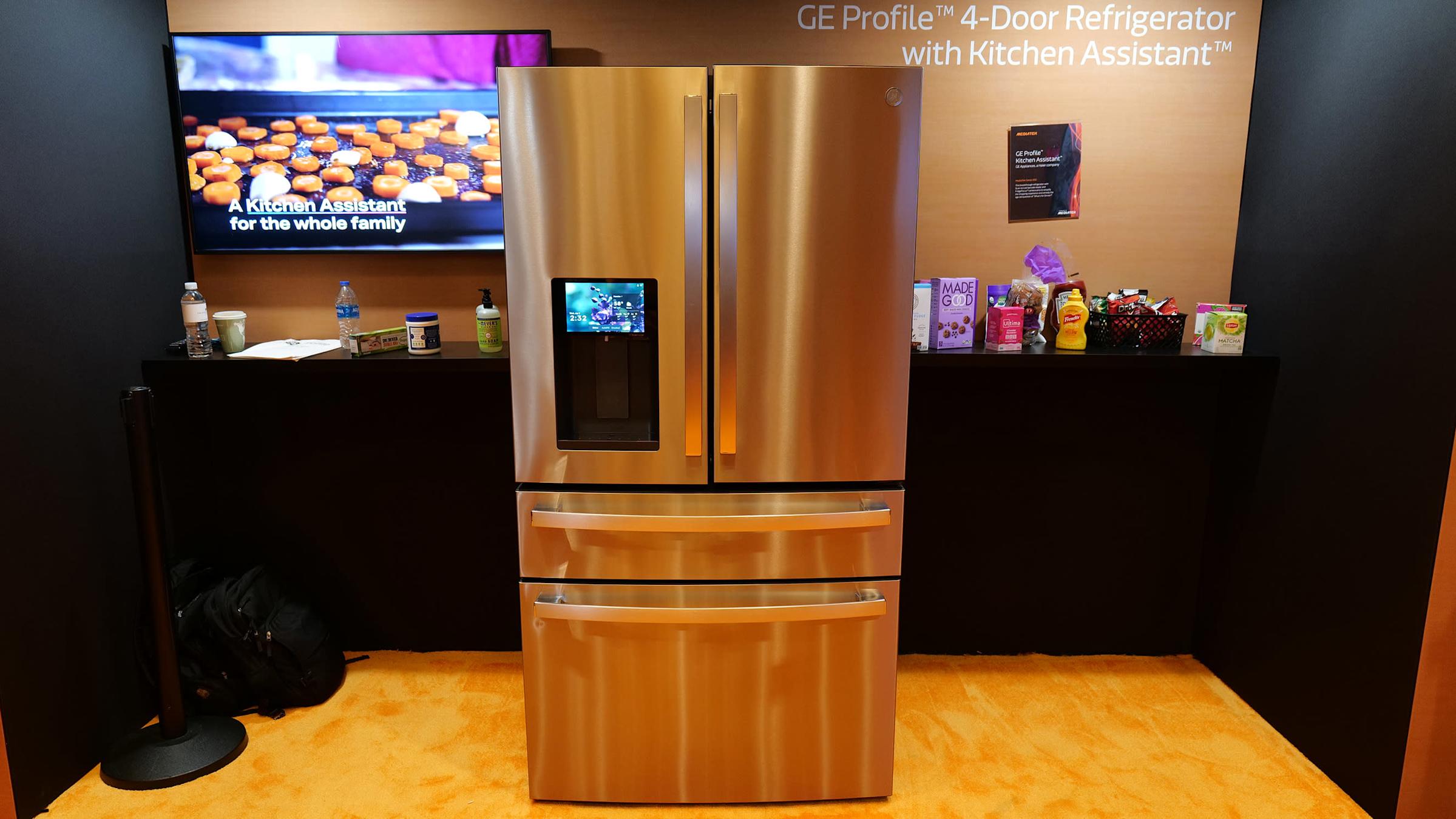
The defining Kitchen Assistant features include a built-in barcode scanner, a shared digital shopping list through the SmartHQ app, Instacart syncing, the FridgeFocus produce-drawer camera, Taste of Home recipe integration, an 8-inch touchscreen, and “Hey, HQ!” voice control for tasks like adding items to a list, asking appliance questions, setting timers, and dispensing water. GE says the scanner recognizes more than 4 million UPC codes, which is a strong sign that this system is meant to work in daily life, not just in a showroom demo.
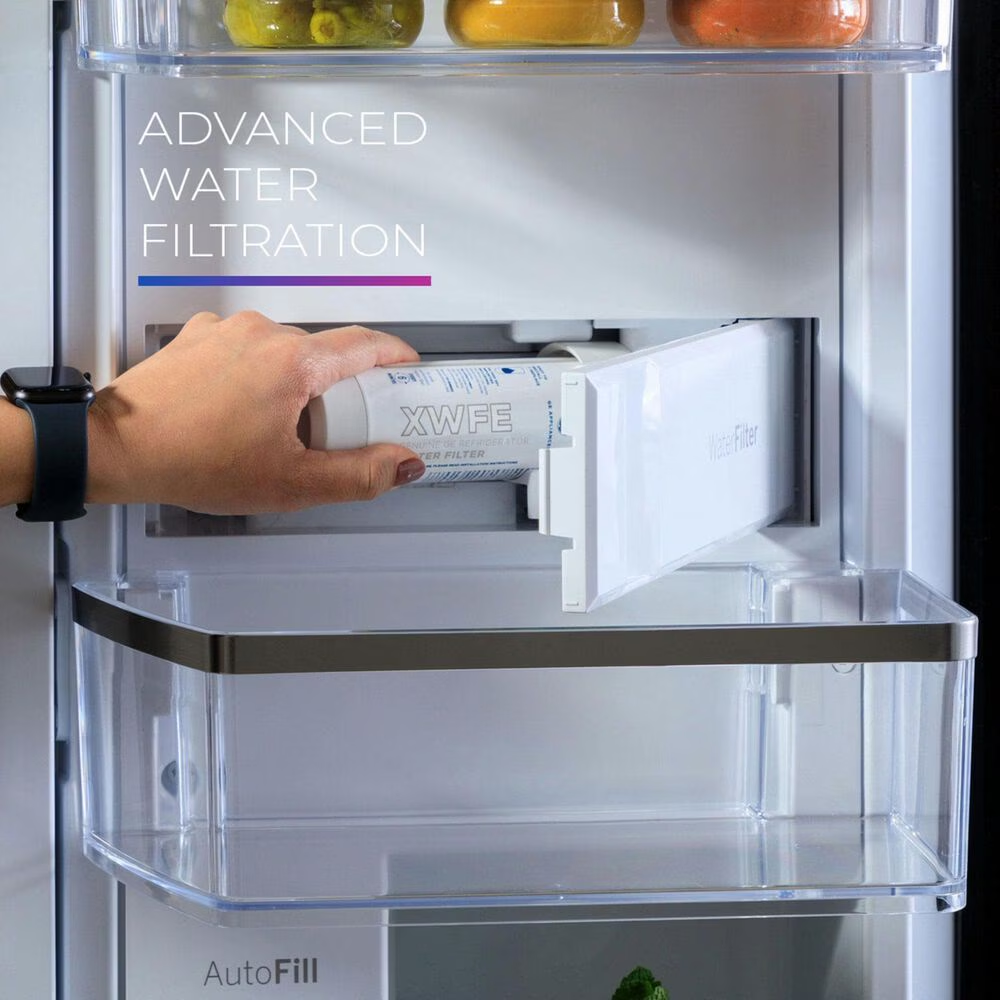
Beyond the smart layer, this refrigerator carries over the premium physical features that matter more in the long run: door-in-door storage, a temperature-controlled flex drawer, fingerprint-resistant stainless steel, a full LED light wall, hands-free AutoFill, hands-free Precise Fill, and built-in Wi-Fi. That combination is why this refrigerator feels serious. The smart layer is not covering for weak fundamentals.
Design and build quality
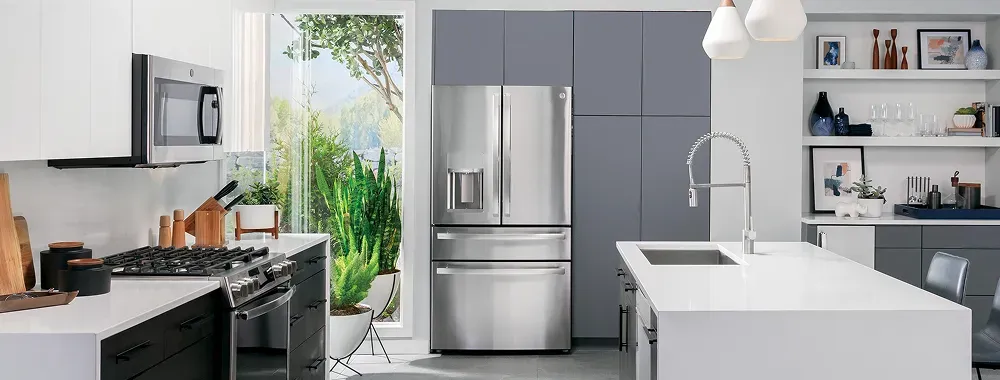
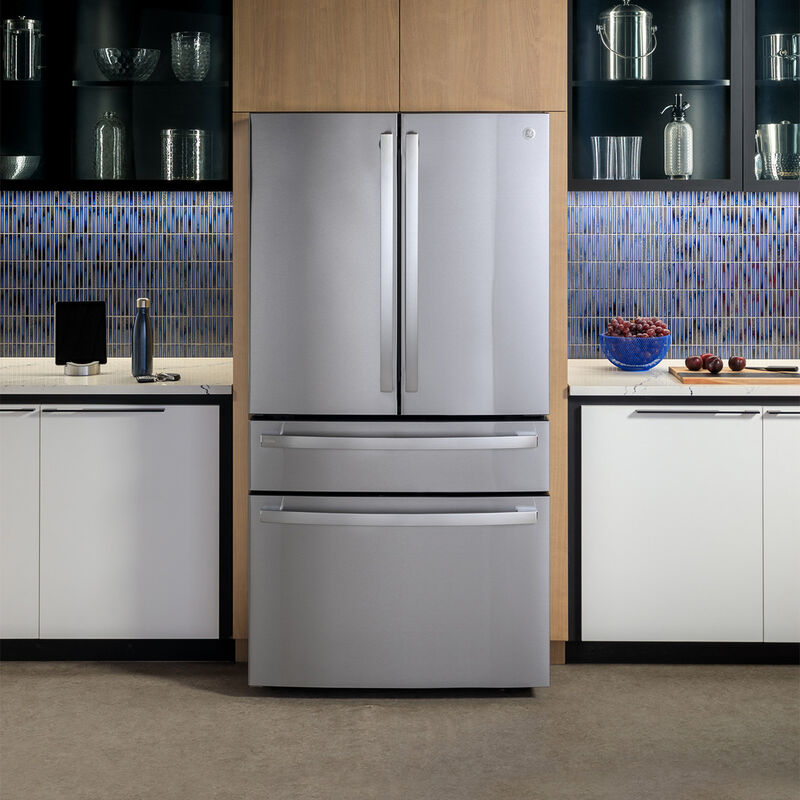
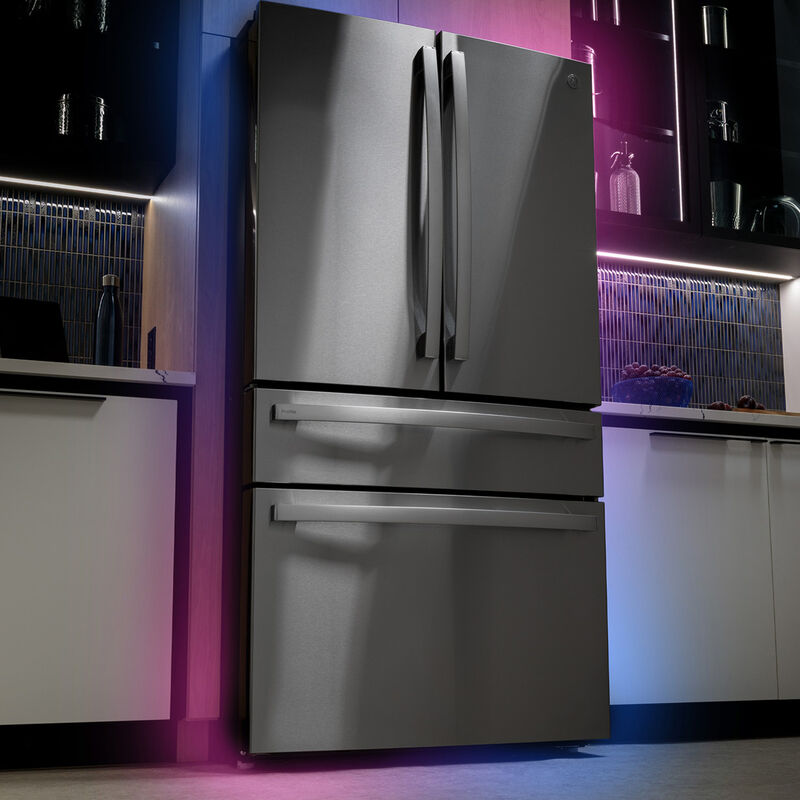
From a design standpoint, GE showed more restraint than most brands do in this category, and we think that was exactly the right move. The fridge looks expensive, but it does not scream for attention. The stainless finish is clean, the four-door layout looks balanced, and the screen is small enough that it does not hijack the entire front of the appliance. That matters more than it sounds. A lot of smart fridges try too hard to look futuristic, and they end up feeling dated before they are even installed.
Here, the technology stays in its place. The refrigerator still looks like a premium kitchen appliance first. We appreciated that immediately. The 8-inch display is large enough to be useful for lists, recipes, and controls, but it does not turn the door into a giant billboard. In daily use, that makes the whole product feel more mature. There is a big difference between adding technology and over-designing around it, and GE mostly stayed on the right side of that line.
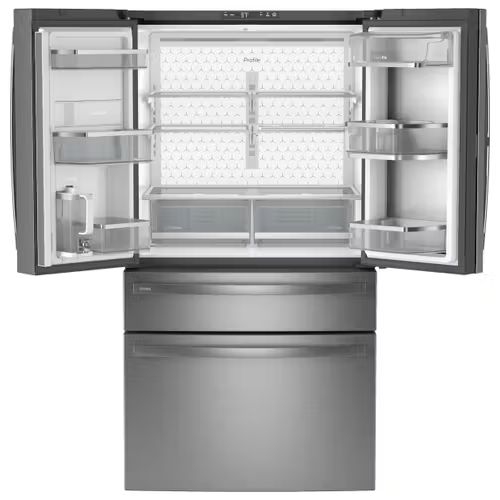
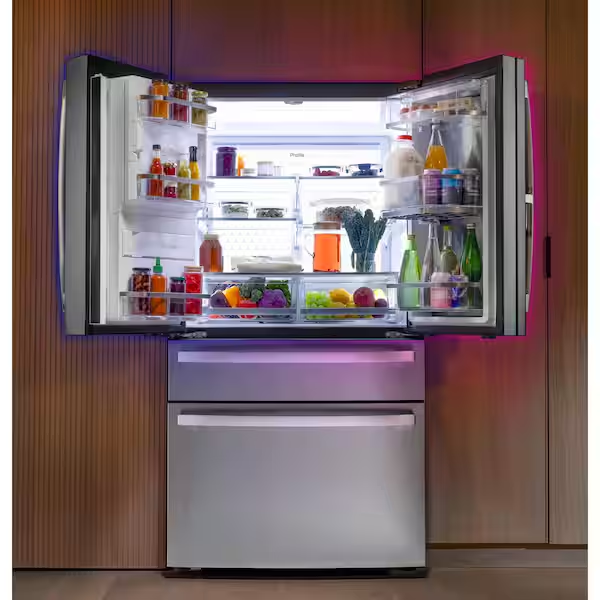
Inside, the details do a lot of the heavy lifting. The full LED light wall is one of those features that sounds cosmetic until you actually live with it. In practice, it makes the interior feel more open, more premium, and easier to use. Dark back corners are one of the quiet annoyances of a lot of refrigerators, especially once they start filling up with leftovers, containers, and produce. Here, the interior stays visible. That reduces everyday friction in a way that is hard to appreciate from a spec sheet alone.
We also liked that the premium touches feel functional rather than decorative. The door-in-door section is not there just to make the front look more interesting. The rotating bin design and the deep storage make it genuinely useful. The middle drawer is not just another zone to mention in marketing copy. It changes how the refrigerator handles real family clutter. Overall fit and finish land where they should for a premium model. This is not a cheap appliance dressed up with software.
Setup and first use
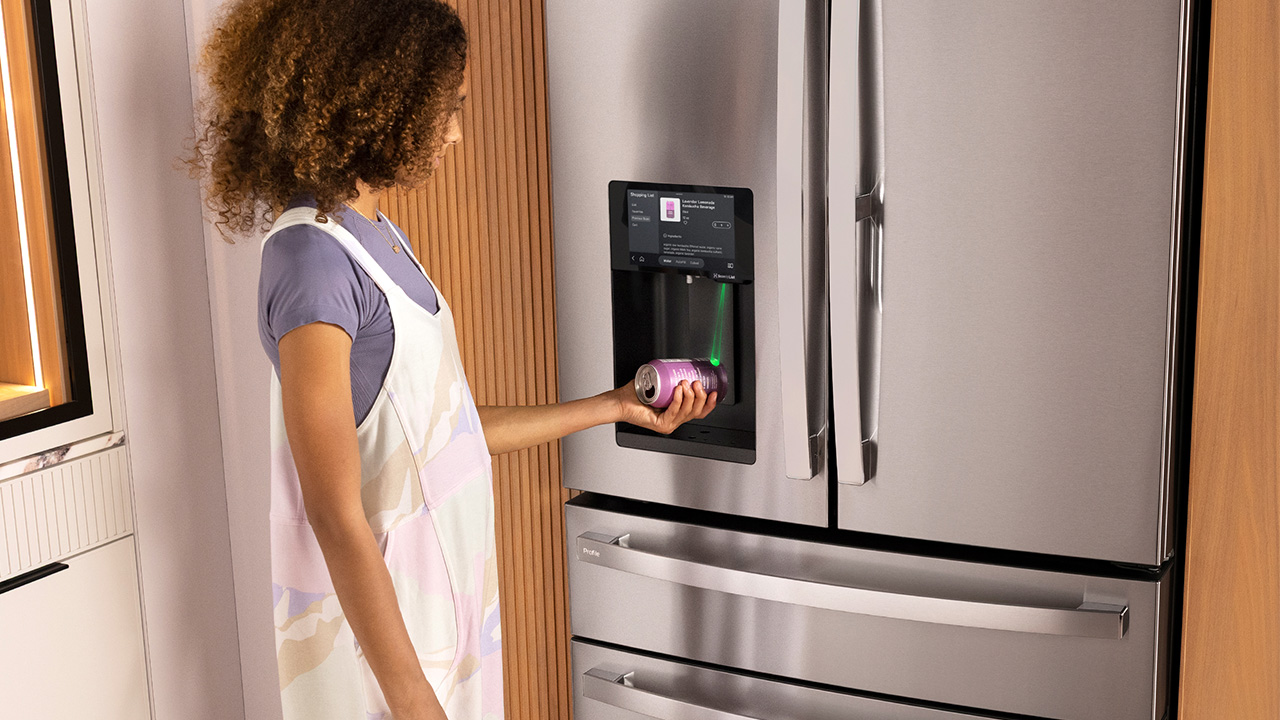
The feature that immediately gives this refrigerator a reason to exist is Scan-to-List. Instead of pretending the fridge can perfectly identify and track every item that comes in and out, GE focused on a much more believable behavior: when you finish something, you scan the package and it gets added to your shopping list. That is a smart idea because it works with human habits instead of trying to replace them entirely.
In practice, this feels far more grounded than the usual smart-fridge promises. You are not relying on the fridge to become some flawless AI pantry manager. You are simply using it to capture the exact item you ran out of—brand, flavor, size, and all—before you throw the container away. That is useful. It is also the kind of feature that can actually save time in a busy household. The part we appreciated most is how specific it is. This is not a vague “smart kitchen ecosystem” pitch. It is a direct answer to a common problem.
The FridgeFocus camera follows that same logic. GE placed the camera where it matters most: around the produce area. That is smart because the produce drawers are exactly where food tends to disappear from memory. You buy spinach, herbs, berries, peppers, or salad mix with good intentions, and then three days later you are standing in a grocery store wondering whether you still have any at home. That is the kind of mental clutter this system is clearly trying to reduce.
We also liked that GE included a physical shutter and app controls for the camera. When a brand puts cameras inside an appliance, privacy needs to be taken seriously. This setup feels more thoughtful than what some competitors have done. It does not eliminate the trust question completely, but it does show that GE understood the concern.
Voice control is here too, and thankfully it seems focused. The “Hey, HQ!” assistant handles practical jobs like list-building, timers, appliance questions, and water dispensing. That is the right scope for something living in a kitchen. We would much rather have a voice assistant that does a few relevant things well than one that tries to become the center of the room.
Storage, layout, and day-to-day practicality
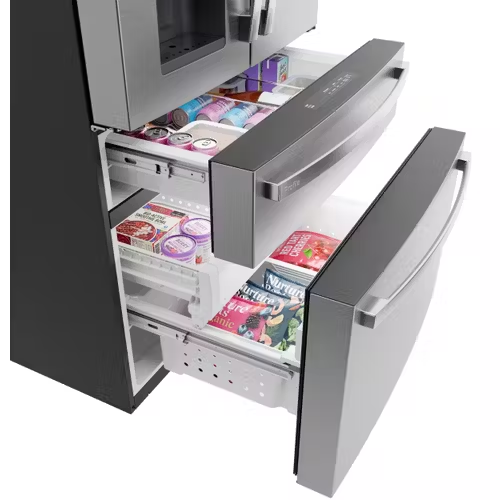
Strip away the smart features and judge this purely as a refrigerator, and the layout is still one of its strongest arguments. The core four-door French-door design works because it reduces clutter in everyday use. The shelves are flexible, the bins are deep, the organization feels intentional, and the middle drawer gives the entire fridge more breathing room.
That middle drawer is a big deal. In a real kitchen, it becomes one of those features you notice every day because of how much stress it removes from the main compartment. Drinks, deli items, snack trays, kid food, lunch-prep containers, party platters, produce overflow—everything that usually gets crammed into awkward spaces suddenly has a proper zone. It is not just convenient. It changes how full the refrigerator feels.
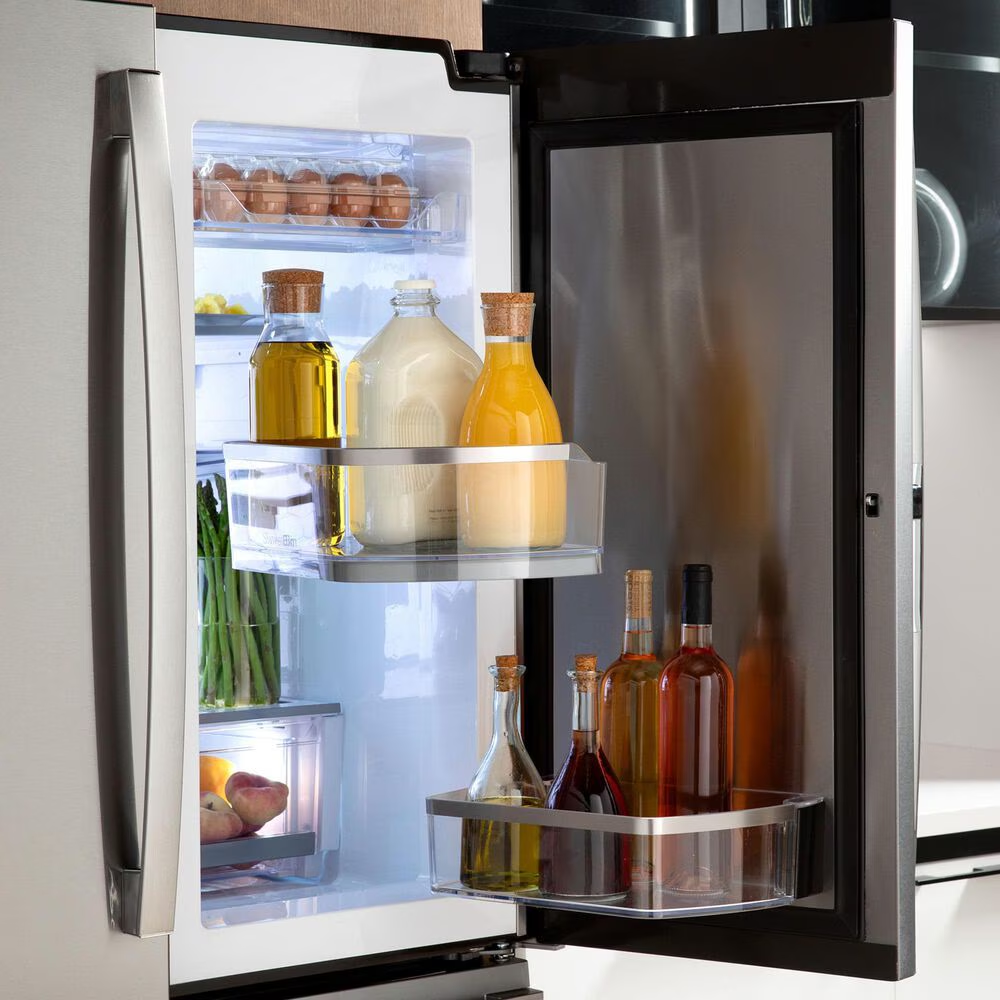
The door-in-door storage is another area where GE did more than the minimum. On many refrigerators, this feature looks better than it works. Here, it actually helps. Frequently used items like condiments, drinks, creamers, and sauces become easier to access without swinging open the full fridge every time. The rotating bin setup makes the section feel more usable, not just more clever.
Shelf flexibility is strong as well. That matters because premium refrigerators are often judged less by how much raw cubic footage they offer and more by how usable that space feels once real groceries are inside. Here, the answer is mostly positive. The refrigerator feels designed by people who understand that family storage is messy and varied. We noticed that this model does not rely on one gimmick to feel premium. It layers a lot of small practical wins together.
And again, the LED light wall deserves credit. Better lighting changes how the whole interior behaves. It makes produce easier to spot, leftovers easier to remember, and packed shelves less frustrating to work with. The effect is subtle until you use it for a while. Then it becomes one of the features you would miss on a cheaper fridge.

Cooling performance and food preservation
This is where the review gets more nuanced, because while the refrigerator is clearly good, it is not flawless in every performance area. The overall cooling foundation feels strong. The dedicated evaporator setup and the general temperature control inspire more confidence than you typically get from a connected appliance trying to sell itself on software alone. The freezer side, in particular, feels dependable and well managed.
Where we felt less convinced was in the finer details of fresh-food storage. The produce care story is good, but it does not strike us as untouchable. The crisper area remains useful and the overall environment inside the fridge is solid, but the produce drawers do not feel like some miracle preservation chamber. Fresh items still need the same basic discipline they always do. If you were hoping this refrigerator would suddenly make produce neglect impossible, that is not the experience here.
The bigger practical point is the door bins. They are useful, they are deep, and they help the refrigerator stay organized—but they are not the coldest place to store temperature-sensitive items. We would be selective about what goes there. Condiments, sauces, drinks that move quickly, and less sensitive items make sense. Milk, butter, or anything you want kept in the coldest part of the refrigerator is better stored on the main shelves. That is the sort of real-life detail buyers deserve to know.
So the cooling verdict is this: the refrigerator performs like a good premium model, not a magical one. It has a solid hardware base, good day-to-day usability, and enough refrigeration competence to support the smart story. But if your only goal is to find the absolute strongest food-preservation machine in the price bracket, this is not a slam-dunk, no-questions-asked answer.
Water, ice, and daily convenience
The dispenser setup is one of the areas where this refrigerator feels especially polished. Hands-free AutoFill and Precise Fill are the kind of features that sound minor until you live with them. Then they become part of the rhythm of the kitchen. Filling a bottle, pitcher, or cooking container without guessing or babysitting the flow is just plain useful. This is not smart-home theater. It is the kind of convenience that actually earns repeat use.
We liked this part of the experience because it feels low-friction. The controls make sense, the feature set matches real kitchen tasks, and the benefit is obvious without needing a whole ecosystem to explain it. Families will use this constantly. So will anyone who cooks regularly.
Ice production is less impressive. It is serviceable, but for a refrigerator at this price, it does not stand out as a major strength. Heavy ice users—especially larger households or people who entertain often—may want more from the system. This is not a dealbreaker, but it does matter. In a premium refrigerator, weak spots tend to show up not in the headline features but in the areas you use every day without thinking.
So our read is straightforward: the water side is excellent and feels thoughtfully executed. The ice side is fine, but not exceptional.
Smart features that feel useful, but still have to earn long-term trust
Smart features are the reason this product exists in this form, so they need to be held to a higher standard than usual. The good news is that GE largely avoided the mistakes that make most smart fridges feel bloated, distracting, or desperate. The better news is that the features here actually connect to familiar household pain points.
Scan-to-List is the star. It feels practical, specific, and easy to understand. FridgeFocus also makes sense because it targets the part of the fridge that is easiest to forget. The shared shopping list, app syncing, and recipe tie-ins all fit the same philosophy: reduce the mental clutter around groceries and meal planning instead of trying to turn the refrigerator into an all-purpose entertainment device.
That said, we are still talking about a software layer attached to a major appliance, and that always raises a longer-term question. A refrigerator can last a very long time. Apps, integrations, voice tools, and digital ecosystems change much faster. That does not make this a bad idea. It just means the smart layer still has something to prove over time.
This matters because the value of the Kitchen Assistant features depends on habit. If your household already lives by shared lists, grocery apps, and constant meal decisions, this refrigerator has a real chance of fitting naturally into your routine. If not, the features may impress you for a few days and then become background decoration. We would be cautious with this product for anyone who already knows they ignore connected features on other appliances.
Value for money
Value here depends almost entirely on whether you are buying this as a premium refrigerator with useful smart support or as a refrigerator you hope will justify its price through technology alone. The standard-depth PVD28HYYFS launched with an MSRP of $4,899, while GE’s current official pricing has also shown it significantly lower at $3,299. That gap changes the conversation a lot.
At the lower number, this becomes a much easier recommendation. You are getting a premium layout, a strong physical feature set, and one of the more believable smart-fridge ideas on the market. At full launch pricing, the burden shifts. Then you really need the Kitchen Assistant features to matter in your household.
The counter-depth PXD22HYYFS adds another wrinkle. It offers the same general concept in a shallower, more built-in-friendly package, but with a clear capacity tradeoff at 22.4 cu. ft. That version will make sense in some kitchens, but for many buyers the standard-depth model is where the overall value feels strongest.
Our verdict on value is simple: if you can get the standard-depth model at an aggressive real-world price and you will actually use the smart workflow, it makes sense. If you are paying close to full MSRP and the connected features are more curiosity than necessity, there are easier ways to spend this kind of money.
Who should buy it
Buy this refrigerator if your household constantly shops, shares grocery responsibilities, forgets produce, or relies on lists to stay organized. This is where the Kitchen Assistant features make sense. It is also a very strong fit for buyers who already wanted a premium four-door French-door refrigerator and like the idea of smart features that feel focused rather than flashy.
We would also recommend it to people who care about day-to-day livability as much as headline specs. The middle drawer, the lighting, the access features, the dispenser, and the overall layout make this feel like a premium appliance in regular use—not just in the showroom.
Who should skip it
Skip it if you want your refrigerator to be as simple and low-tech as possible. Skip it if you rarely use shopping apps, dislike connected ecosystems, or already know that you will never scan packages after the first week. Skip it as well if your priorities are top-tier ice production, the coldest possible door storage, or purely refrigeration-first value without added digital complexity.
And if the only way this product makes sense in your budget is at or near full MSRP, we would be careful. At that level, you need to be honest about whether the smart features will become part of your routine or just a pricey novelty.
Final verdict
The GE Profile Smart 4-Door French-Door Refrigerator with Kitchen Assistant is one of the rare smart fridges that feels like it understands what people actually need from a kitchen appliance. It does not try to dazzle with a giant screen or bury you in futuristic promises. Instead, it focuses on a handful of annoyances that matter: forgetting groceries, losing track of perishables, and adding friction to meal planning.
What makes it work is that the smart layer sits on top of a refrigerator that was already easy to like. The storage is well thought out. The flex drawer is genuinely useful. The interior lighting is excellent. The dispenser features are strong. And the whole appliance feels premium in the ways that matter during daily use.
It is not perfect. The ice production is not standout, the door bins are not the coldest zone, and the software layer still has to prove long-term value the way any connected appliance does. But unlike most smart refrigerators, this one feels like it has a real job. And that makes all the difference.
Our verdict: if the Kitchen Assistant features fit how your household actually shops and cooks, this GE is a compelling premium buy. If you want a simpler, more traditional fridge with no digital strings attached, there are safer ways to spend the money.
FAQ
What is the exact model name?
The main model is the GE Profile PVD28HYYFS, officially the GE Profile ENERGY STAR 27.9 Cu. Ft. Smart 4-Door French-Door Refrigerator with Kitchen Assistant. The counter-depth version is the PXD22HYYFS.
How big is it?
The standard-depth PVD28HYYFS offers 27.9 cu. ft. of capacity and measures about 69.875 inches high, 35.625 inches wide, and 36.75 inches deep. The counter-depth version is 22.4 cu. ft.
What does Kitchen Assistant actually do?
It adds a built-in barcode scanner, shared shopping lists through SmartHQ, Instacart syncing, the FridgeFocus produce camera, recipe integration, and “Hey, HQ!” voice commands for tasks like timers, list-building, and water dispensing.
Is the barcode scanner actually useful?
Yes—more useful than most smart-fridge ideas, in our view. It focuses on replenishing the items you are running out of instead of trying to maintain a perfect live inventory of everything in the fridge.
Does it have a camera inside?
Yes. The FridgeFocus camera is built into the interior light bar and is designed to show the produce-drawer area and related fridge contents in the app. GE also includes a physical shutter and app-based privacy controls.
Is it still a good refrigerator if you ignore the smart features?
Yes, it still has a lot going for it because the layout, drawer design, lighting, and overall organization are all strong. But the full value of this specific model is tied to the Kitchen Assistant system, so it makes much less sense if you know you will never use those tools.
What are the biggest weaknesses buyers should know about?
The biggest ones are the warmer door bins, average ice production, and the fact that the smart layer still needs to prove how well it will hold up over the long term.
Is it worth the price?
It is much easier to recommend when priced closer to the lower end of its real-world range. At a discount, the combination of premium layout and useful smart features is persuasive. At full price, you need to be sure the Kitchen Assistant features are something your household will actually use.
Explore the GE Profile Smart 4-Door French-Door Refrigerator with Kitchen Assistant Gallery
Every image from this article, gathered in one clean place. Tap any photo to open it larger.