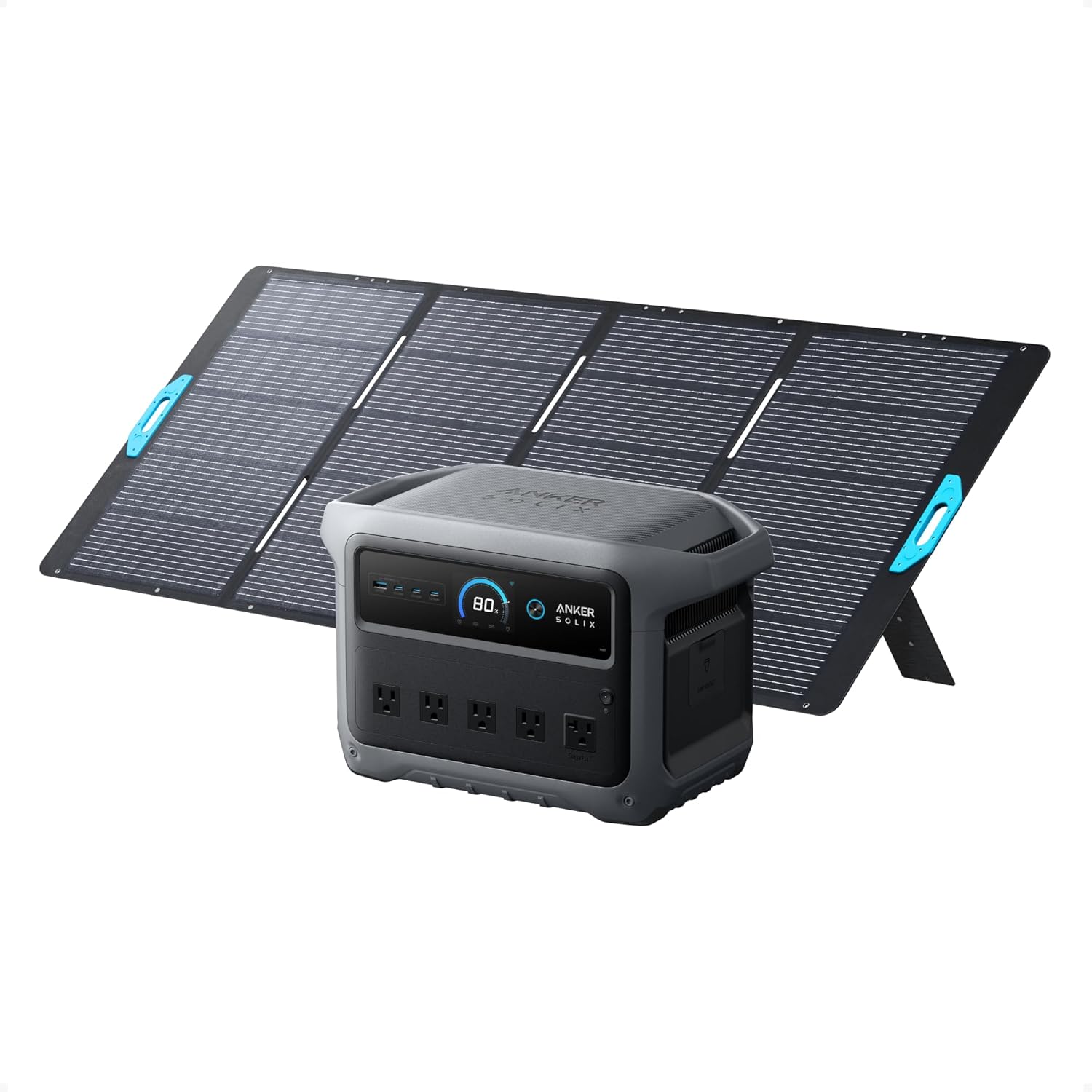

Anker SOLIX C1000 Gen 2
Pros
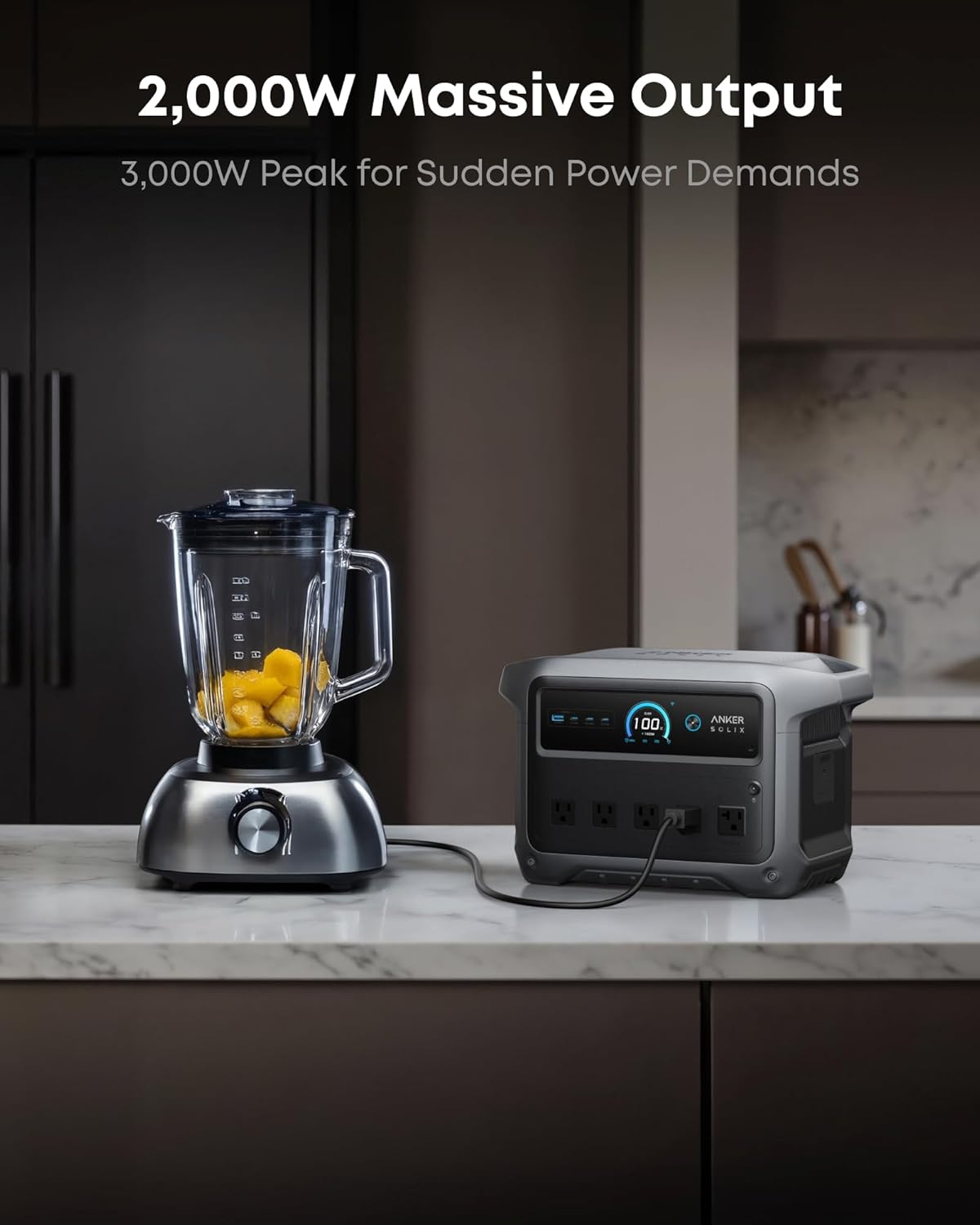
- 2,000W continuous output is strong enough for real appliances, tools, and home essentials
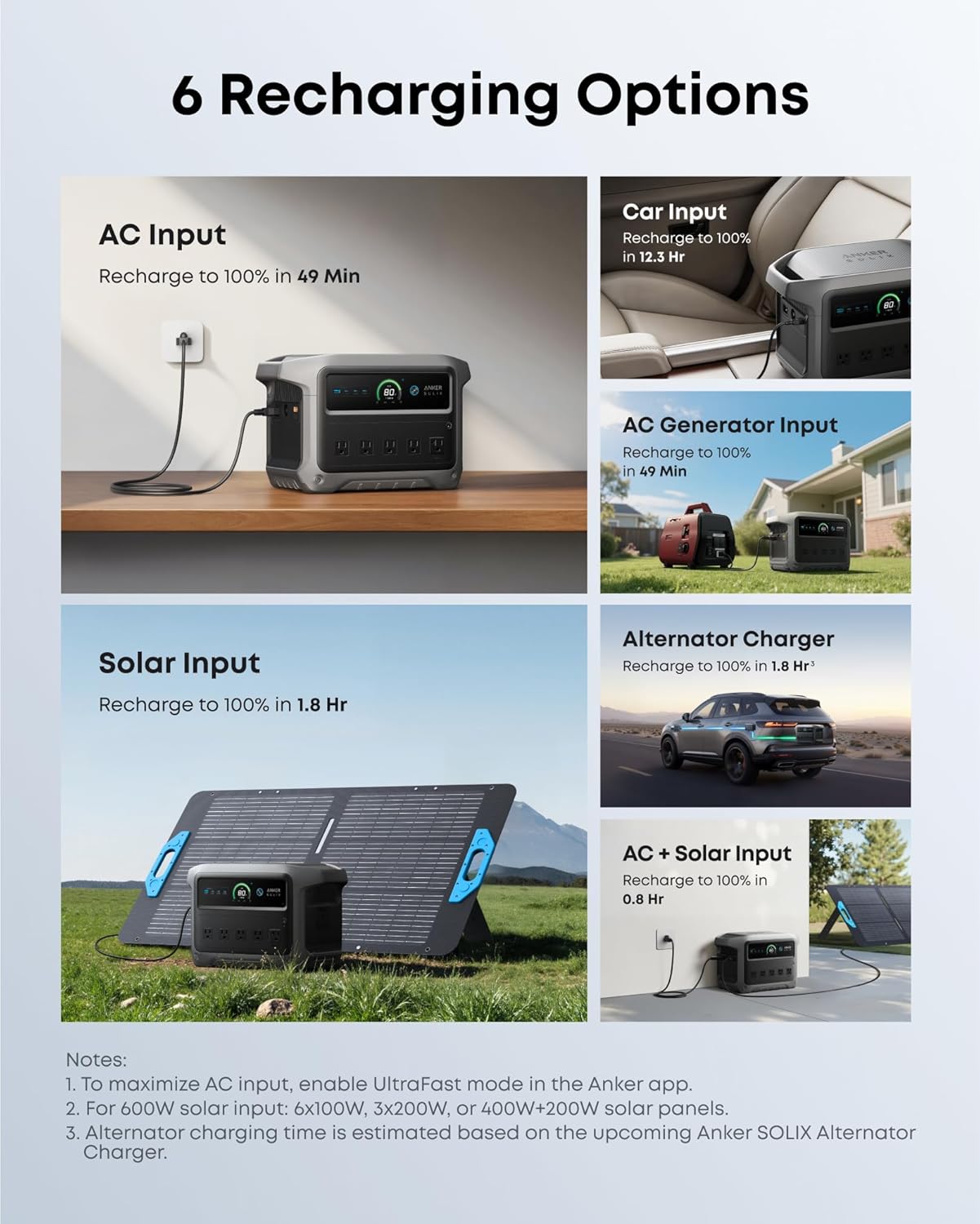
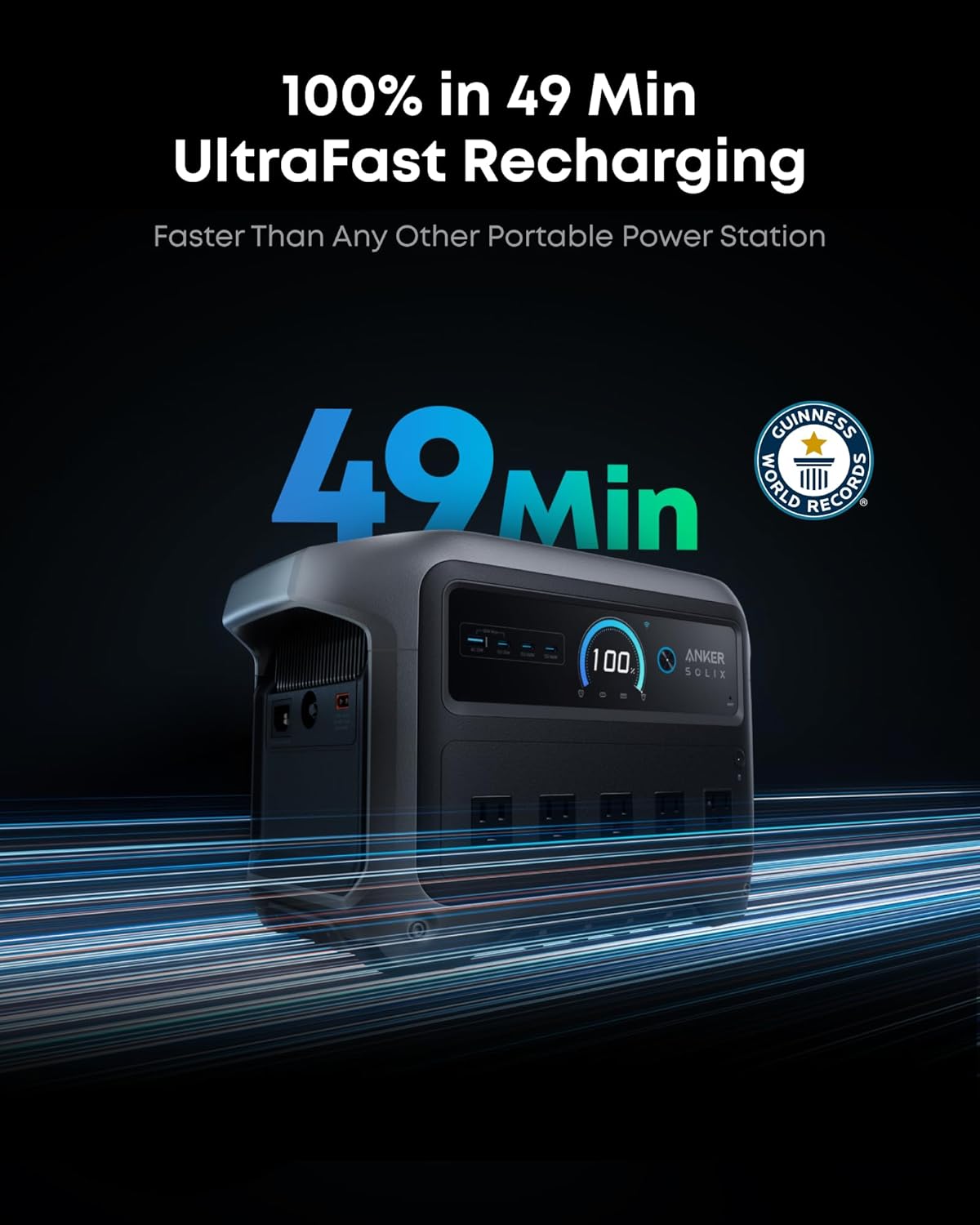
- 49-minute UltraFast AC charging makes the unit far more convenient to own
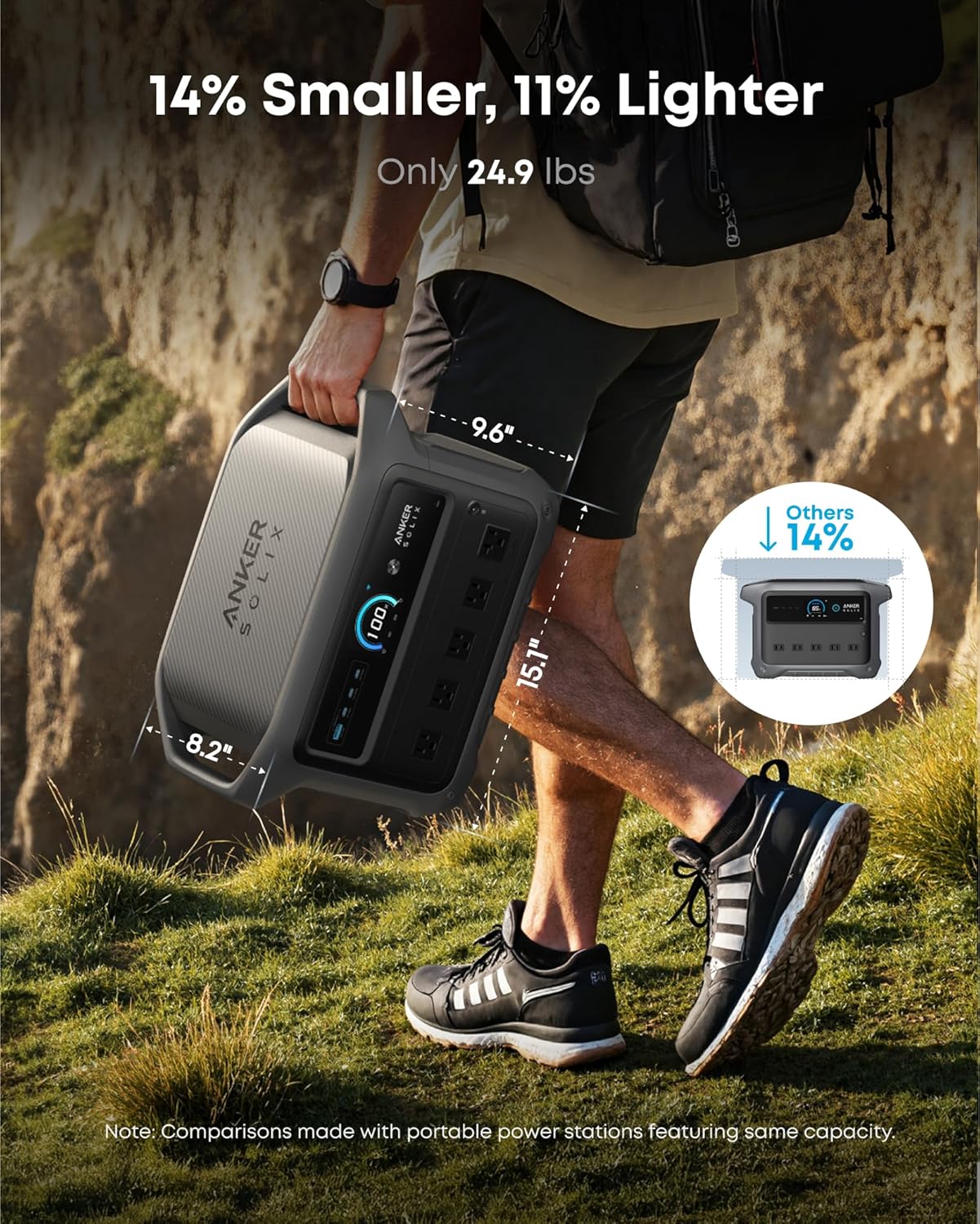
- 24.9 lb weight and compact dimensions make it genuinely manageable for a 1kWh station
- Excellent port selection, especially the dual 140W USB-C ports
- 600W solar input is strong for this size class
- 10ms UPS adds real usefulness for home-office and backup scenarios
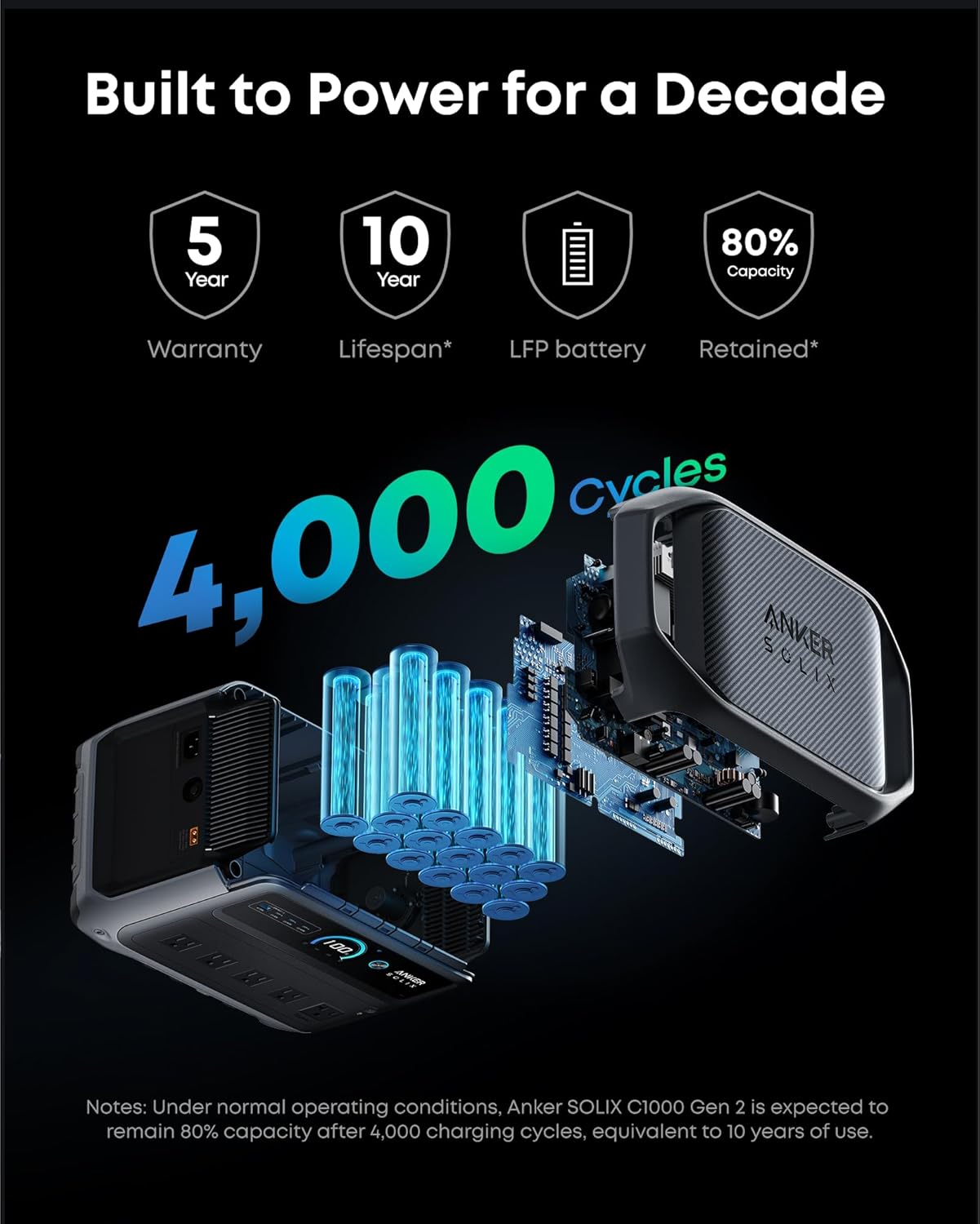
- LFP battery chemistry with a 4,000-cycle / 80% claim gives it reassuring long-term appeal
Cons
- No expandable battery support
- Fans get loud during fast charging and heavier loads
- Best-case charge speed depends on app settings and battery temperature
- Not waterproof
- Heavy AC appliances drain the battery quickly, as they do with every 1kWh-class unit
1,024Wh capacity, 2,000W continuous output, 3,000W peak output, 49-minute UltraFast AC charging , 600W solar input , 10 ports , 10ms UPS , and a much better size-to-power ratio than many mid-size rivals.
No battery expansion, fan noise when the unit is pushed hard, app dependence for the fastest charging mode, and the usual truth of this class: 1kWh goes quickly once you start leaning on heaters, microwaves, or other heavy AC loads.
The Anker SOLIX C1000 Gen 2 impressed us for a simple reason: it feels like a portable power station designed for real life instead of brochure life. After spending time with it, what stood out most was how well it balances the things that usually fight each other in this category—power, recharge speed, portability, and day-to-day usability.
It is powerful enough to handle serious appliances, compact enough that we did not dread moving it, and polished enough to feel like something you would actually keep in rotation instead of dragging out only for emergencies. It is a very smart fit for buyers who want one battery for outages, travel, work, and everyday backup. It is a weaker fit for anyone who already knows they will want expansion, silence under stress, or long runtimes on high-draw appliances.
What we tested
With a product like this, the real question is never whether it can light up a spec sheet. The real question is whether it fits into normal use without becoming annoying. That is where we focused our time.
We paid close attention to the things that actually decide whether a mid-size power station earns its place: how manageable it feels to move, how quickly it recovers after use, how well the port layout supports modern gear, how credible the inverter feels once real appliances are plugged in, and whether it makes sense as a home outage bridge instead of just a weekend camping box.
We also paid attention to the less glamorous parts, because those are the ones buyers live with longest. Fan behavior matters. App dependence matters. Charging friction matters. Runtime expectations matter. This class lives or dies on those practical details.
How we tested it
We approached the C1000 Gen 2 the way most buyers will actually use it: not as a fantasy whole-home system, but as a flexible backup and travel unit.
That meant looking at it through several lenses. First, we treated it like an outage companion—something that should keep the essentials alive without drama. Then we looked at it as a mobile power hub for work, travel, and creator gear, where USB-C output, charge speed, and portability matter just as much as raw AC wattage. We also spent time with the setup experience, the app, the display, and the everyday handling of the unit, because this is the sort of product that can be technically good and still irritating to live with if the details are not right.
The most important thing that became clear over time was this: the C1000 Gen 2 makes the strongest case for itself when you judge it as a serious all-rounder rather than a mini whole-house backup system.
Design and build quality
Anker did not try to make this look futuristic, and that was the right call. The C1000 Gen 2 has the kind of design we tend to appreciate more the longer we live with a product. It looks clean, dense, and purposeful. Nothing about it feels toy-like. It looks like a real piece of equipment.
What stood out to us most was the shape. Plenty of so-called portable power stations are technically movable, but still awkward enough that you start avoiding that task after the first few days. This one lands in a more usable middle ground. At 24.9 lb with dimensions of roughly 15.1 x 8.2 x 9.6 inches, it feels substantial without crossing into the territory where portability becomes a marketing word instead of a lived reality.
That size matters more than people think. In practice, a product like this ends up moving between rooms, into a car trunk, next to a desk, into a closet, onto a camping setup, or beside the kitchen during an outage. The C1000 Gen 2 feels built for that kind of movement. It is still a battery box, yes, but it is one of the few in this class that does not punish you for actually using it like one.
The build itself feels reassuring. It has the kind of sturdy, compact density that suggests it can handle regular use without feeling fragile. We also liked the front-panel layout. It is clear, easy to read, and does not force you into a learning curve just to see what is happening.
There are limits here. It is not waterproof, and that is worth remembering if your idea of outdoor use leans rougher than casual. This is a durable portable station, not a toss-it-anywhere outdoor tank.
Setup and first use
One of the reasons Anker products often land well with mainstream buyers is that the company understands that setup is part of the product. That is true here too.
The C1000 Gen 2 feels approachable from the start. The display is easy to understand, outputs are simple to manage, and the app adds the sort of control that is genuinely useful rather than decorative. You can monitor charge levels, adjust charging speed, toggle outputs, set limits, and make use of scheduling features without the whole thing turning into a software project.
That said, one of the biggest headline features comes with an asterisk that matters. The much-advertised 49-minute full recharge depends on UltraFast Charging, and that mode needs to be enabled in the app. It also works best when the battery is at the right temperature. We do not view that as a dealbreaker, because the charging performance here is genuinely impressive, but it is the kind of fine print buyers deserve to understand before they assume every charge will hit the brochure number.
In practice, though, the speed still changes the ownership experience. A mid-size power station that recharges this quickly is simply easier to use. You are more willing to take it on trips. You are more willing to drain it during an outage. You are more willing to use it for convenience instead of saving it only for “serious moments.” Fast charging is not just a nice spec here. It is part of the reason the product feels more useful.
The app experience overall is solid, though not perfect. It does what it needs to do, and the added control is valuable, but it does not feel so essential that the unit becomes unpleasant without it. That balance matters.
Real-world performance
This is where the C1000 Gen 2 earns its keep.
On paper, 2,000W continuous output and 3,000W peak output already put it in serious territory for a 1,024Wh station. In use, what we appreciated was that it actually behaves like a proper appliance-capable unit rather than just a giant gadget charger with inflated ambitions.
It handled a broad mix of realistic loads with confidence. That is the point where many mid-size stations either start to feel strained or force you into constant mental calculations. The C1000 Gen 2 felt more relaxed than that. It has enough inverter headroom that normal use does not feel delicate.
This is the distinction that matters: output is not the problem here. Capacity is. The unit is powerful enough to run things people genuinely care about—fridges, routers, laptops, lights, coffee makers, tools, fans, and more—but it is still a 1,024Wh battery. That means it can do more than some buyers expect in the moment, while still running into the same hard runtime limits that define the class.
We found that the product makes the most sense when used as a “keep life going” station rather than a “run everything like normal” station. That is not a weakness in the design. It is the honest role this size serves best.
Home backup performance
As a home backup unit, the C1000 Gen 2 hits a sweet spot that a lot of people overlook.
Most buyers do not actually need portable whole-home backup. What they need is a station that can keep the refrigerator safe, the router alive, the phones charged, the laptop running, the lights on, and maybe a CPAP or a few short kitchen loads covered while the power situation settles. This product is very convincing in that role.
The refrigerator question always comes up first, and the answer here is encouraging. This is a realistic fridge-bridging station, not a fantasy one. Runtime will still vary depending on the appliance, room conditions, and usage, but the class, output ceiling, and overall behavior all point in the same direction: this is the kind of unit that can keep essentials running through the part of an outage that matters most.
We also liked how well it makes sense for desk and home-office duty. A battery that can support an 8-hour workday for laptop-centered use, or stretch much longer while running a modest desk setup, is exactly the kind of practicality that gives a product real staying power. That is the sort of performance people actually remember and appreciate.
The 10ms UPS function is another major plus. We would still reserve the most mission-critical expectations for more dedicated solutions, but as a fast-transfer backup feature for laptops, networking gear, and certain medical or work-related setups, it adds real value.
Camping, travel, and off-grid use
This may be the most natural use case for the C1000 Gen 2.
The reason is not that larger batteries are irrelevant. It is that bigger does not always mean better once you actually have to move the thing, store it, recharge it, and live with it. The C1000 Gen 2 feels like a travel-friendly size without becoming a compromise-heavy toy.
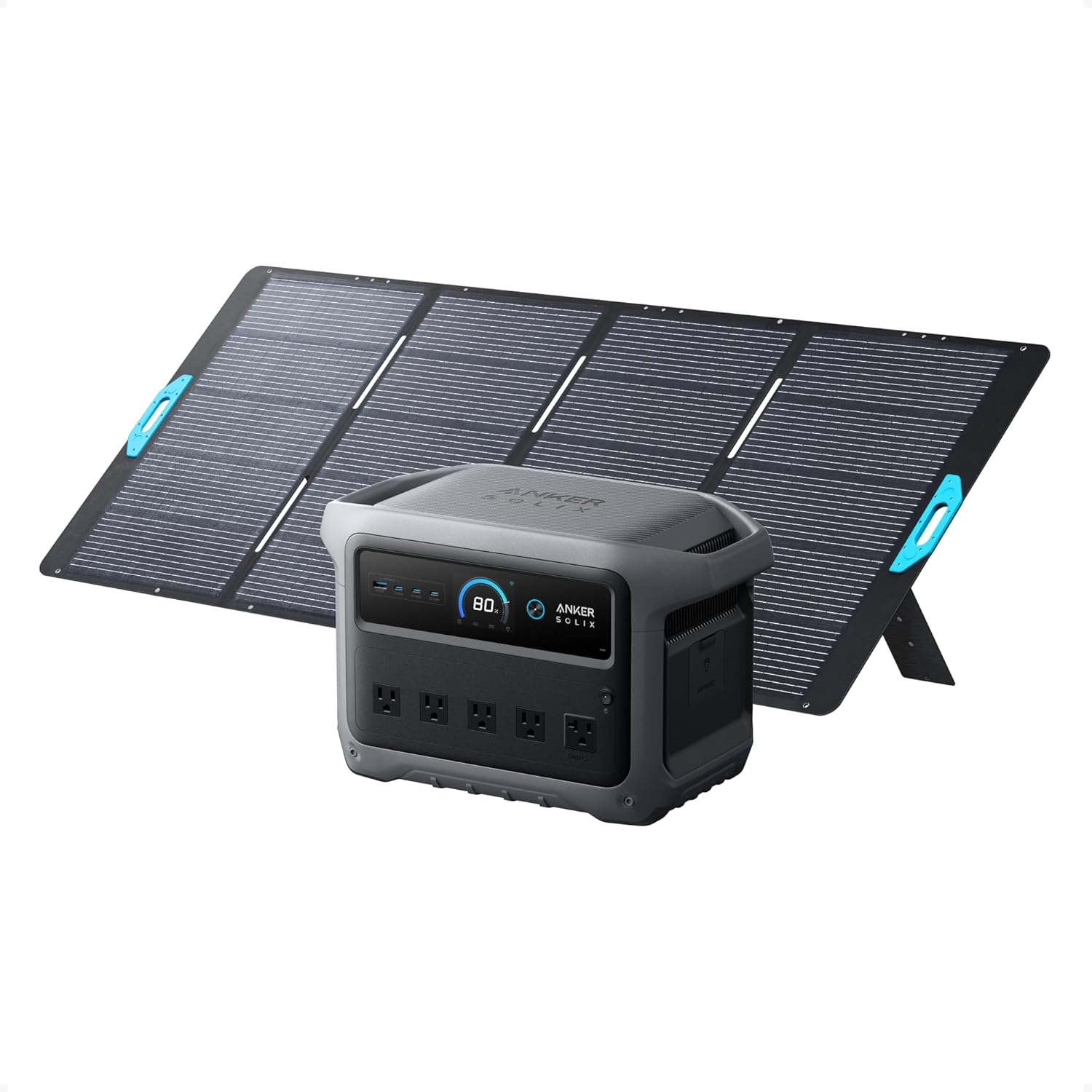
For road trips, van weekends, overlanding setups, and creator work, it hits a very useful balance. The port mix is especially important here. You get five AC outlets, two 140W USB-C ports, an additional USB-C, a USB-A port, and a 12V car socket. That makes it much more flexible than products that still treat USB-C like a side feature instead of a main one.
In daily use, those 140W USB-C ports matter. They make the station feel properly modern. Laptops, cameras, drones, phones, tablets, and other high-demand gear can be powered or recharged without constantly resorting to bulky wall adapters and wasting inverter power on the process. That is a real convenience gain, not a spec-sheet vanity point.
The 600W solar input also helps the travel story. We like seeing serious solar support at this size because it turns the unit into something more than a one-and-done battery. Real solar charging will always depend on conditions, but at least the ceiling here is high enough to make the feature meaningful.
Where we would temper expectations is prolonged heavy off-grid AC use. If the plan is to run demanding appliances for hours on end, this is not the right size class. As a compact, capable mobile energy hub, though, it makes a lot of sense.
Convenience, noise, and everyday livability
This is one of the strongest and weakest parts of the experience, depending on what you are doing.
At lighter loads, the C1000 Gen 2 is easy to live with. The screen is clear, the controls are straightforward, and the general day-to-day behavior feels polished. It does not fight you. That matters more than it sounds. A power station can have great specs and still become tiresome because the interface is clumsy or the monitoring is poor. This one avoids that.
But the noise story needs honesty.
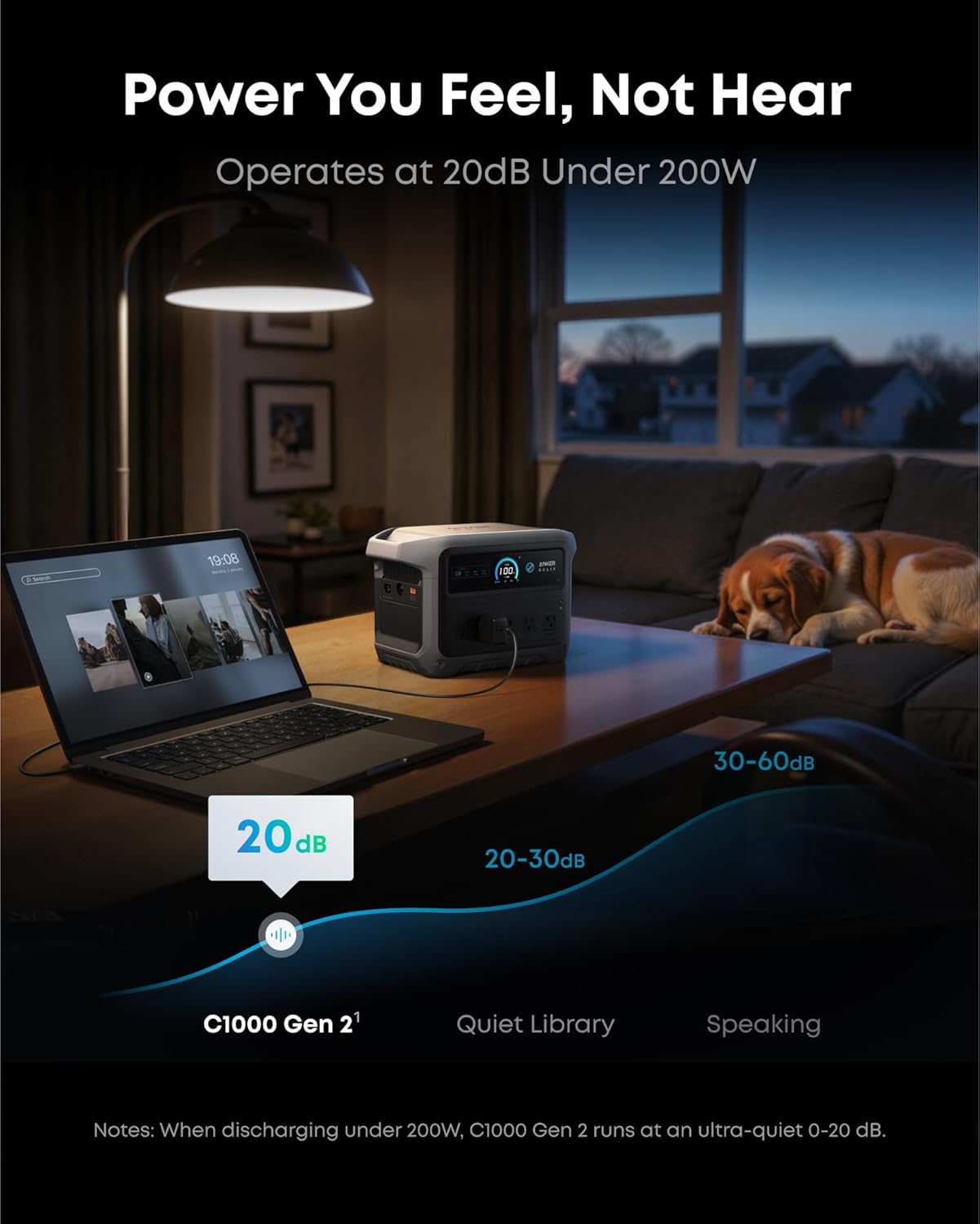
Anker promotes 20dB operation, and technically that may reflect certain low-demand conditions. In practice, once you start fast charging or leaning on the unit with heavier loads, the fans become a very real part of the experience. This is not a silent machine under pressure. It is a capable one. There is a difference.
We can live with that tradeoff because the loudest behavior is tied to one of the product’s biggest strengths: very fast charging and strong output. Still, buyers who are especially noise-sensitive should take it seriously. We would not choose this as a bedside heavy-load battery for overnight use. In a kitchen, office corner, garage, camper, or utility space, the compromise is much easier to accept.
Flaws and frustrations
The biggest frustration is also one of the clearest buying filters: there is no expandable battery support.
For a lot of buyers, that will not matter at all. In fact, it is part of why the unit stays manageable in size and weight. But for others, it is the one weakness that changes the buying decision immediately. If you want to start small and grow later, this is not built for that.
The second frustration is fan noise under heavy operation. It is not subtle when the unit is pushed. We do not think it sinks the product, but it absolutely shapes where and how we would want to use it.
The third is the charging headline itself. Yes, the speed is excellent. No, it is not a one-button reality in every condition. The app requirement and temperature dependency are both worth knowing.
And then there is the limitation some buyers always rediscover the hard way: 1kWh is still 1kWh. The C1000 Gen 2 is powerful enough to tempt you into unrealistic expectations if you look only at wattage. It can run more than you might assume, but it cannot run everything for long.
Value for money
The value story here depends heavily on price.
At a strong sale price, the C1000 Gen 2 looks like a very smart buy. You are getting LFP / LiFePO4 chemistry, a claimed 4,000-cycle lifespan to 80% capacity, fast AC charging, strong solar input, serious inverter power, excellent USB-C support, and a form factor that feels much more livable than many rivals in the same general class.
At full price, the lack of expansion becomes harder to ignore. Not fatal, but harder to ignore.
Our view is that this is a product that makes the most sense as a “buy it right, keep it for years” purchase. The hardware feels well judged. The portability is real. The performance is honest. If you shop it well, the value case becomes much easier to defend.
Who should buy it
We would recommend the Anker SOLIX C1000 Gen 2 to buyers who want one serious portable battery that can cover a lot of ground without becoming a burden.
It makes especially good sense for people who want outage backup for essentials, a power source for road trips and camping, a flexible station for creator or drone gear, or a reliable home-office safety net. It is also a very strong fit for buyers who care about recharge speed, because that is one of the features that genuinely changes how often this product will get used.
If you want a station that is powerful, compact, modern in its port mix, and easy enough to move that you will actually keep using it, this is a very compelling option.
Who should skip it
We would skip the C1000 Gen 2 if expandability is high on the priority list. We would also skip it if the main goal is to run heavy appliances for long stretches, because that is where the capacity limit becomes impossible to ignore.
It is also not our first pick for buyers who are especially sensitive to noise during fast charging or hard AC use. And if you already know you need a much longer-runtime backup solution, it is smarter to move up in size than to expect this unit to become something it is not.
Final verdict
What we appreciated most about the Anker SOLIX C1000 Gen 2 is that it feels like a grown-up product. It understands what most people actually need from a portable power station and focuses on that instead of trying to be everything at once.
It is not the biggest battery you can buy. It is not the quietest under stress. It is not the most expandable. But in real use, it gets an enormous amount right: strong output, fast recharge, modern ports, good solar support, compact storage, and true portability for its class.
That is why we came away liking it. The C1000 Gen 2 feels less like a niche gadget and more like a genuinely useful piece of household and travel equipment. If your expectations are aligned with what a great 1,024Wh station should actually do, this is one of the easiest mid-size power stations to recommend.
FAQ
Is the Anker SOLIX C1000 Gen 2 good for home backup?
Yes, as long as you understand what 1,024Wh really means. It is a strong backup option for essentials like routers, lights, laptops, phones, certain medical devices, and refrigerator bridging, but it is not a whole-home solution.
Can it run a refrigerator?
Yes, that is one of the more believable use cases for it. Exact runtime depends on the fridge and how it cycles, but this is the kind of station that makes fridge backup feel realistic rather than theoretical.
How fast does it actually recharge?
With UltraFast Charging enabled, Anker rates it at 0 to 100% in 49 minutes. That is one of the best things about the product, though the best-case result depends on settings and battery temperature.
Is it better than the original C1000?
That depends on what matters to you. The Gen 2 is stronger on portability, output, recharge speed, and UPS performance. The original model remains the better choice if expandable capacity is a priority.
Is it quiet?
At lighter loads, it is easy enough to live with. Under heavy charging or heavier AC use, the fans become clearly noticeable.
Is it worth buying for camping and road trips?
Yes. In fact, that is one of its strongest use cases. The size, weight, port mix, solar input, and recharge speed all make it very well suited to travel and mobile power duty.
Explore the Anker SOLIX C1000 Gen 2 Gallery
Every image from this article, gathered in one clean place. Tap any photo to open it larger.